

Class A measurement
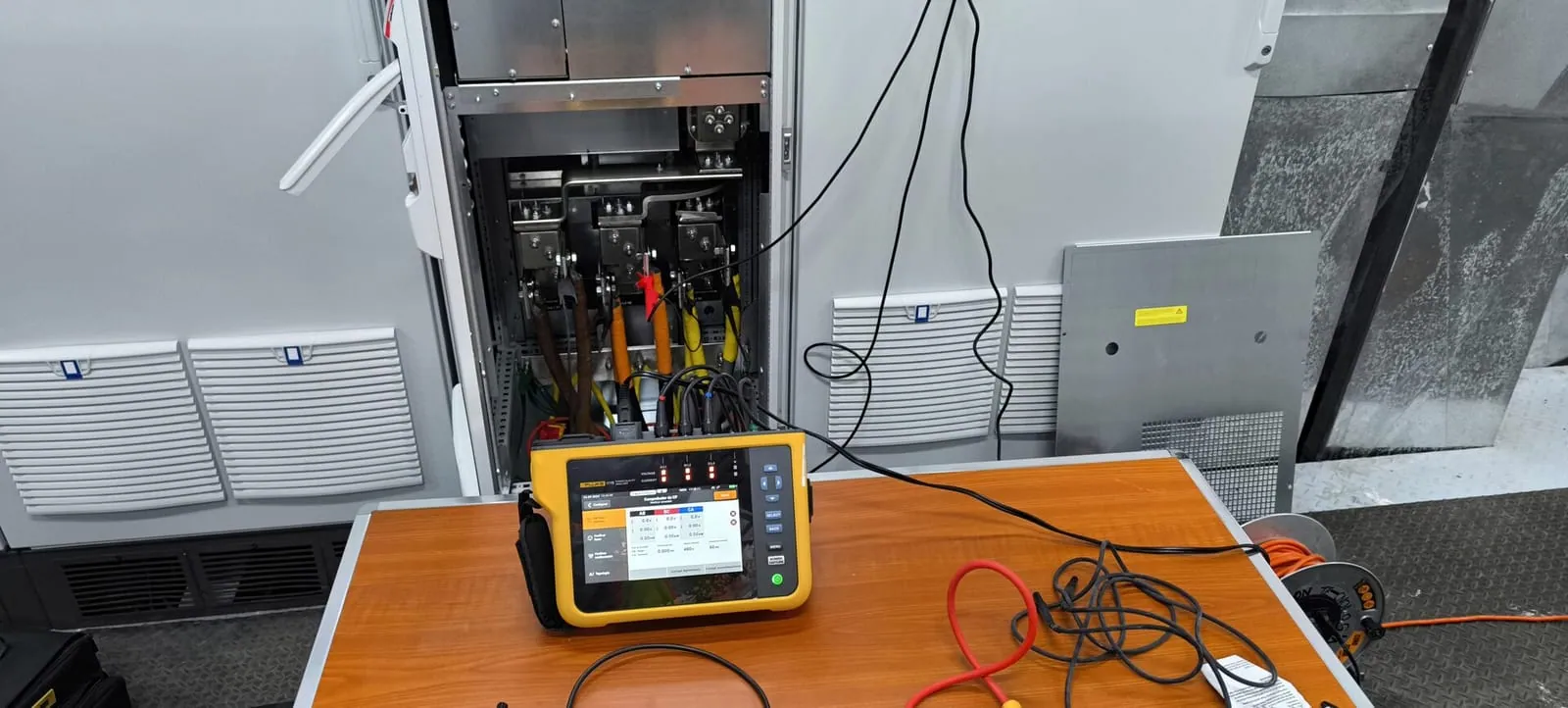
Fluke 1770/1775/1777 — IEC 61000-4-30 Class A accuracy. The standard utilities and international audits accept without argument.
We measure harmonics, flicker, unbalance and voltage events with Class A Fluke instrumentation. You get the complete report, the identification of each source and a mitigation proposal with estimated payback.
If you recognize one or more of these symptoms in your plant, there is a measurable, fixable root cause. We identify it in a single site visit.
High-order harmonics or poorly attenuated transients trip electronic protections. Without measurement there is no diagnosis — only endless equipment replacement.
Harmonics raise eddy-current losses in the core (high K-factor). A 1000 kVA transformer may need derating to 700 kVA effective. Replacing it costs 10× more than filtering the harmonics.
In Panama, the distribution utility applies the harmonic emission limits of the ASEP Distribution and Commercialization Regulation, referred to the contracted current, and can pass on penalties. IEEE 519-2022 is the technical reference for designing the mitigation. With no prior study, the problem surfaces in the last mile.
Concrete services, not generic ones. Every item comes with verifiable scope and documented deliverables.
Fluke 1770/1775/1777 — IEC 61000-4-30 Class A accuracy. The standard utilities and international audits accept without argument.
THD/TDD, individual harmonics, K-factor, Pst/Plt flicker, unbalance, voltage events (sags/swells) classified per ITIC and IEEE 1159.
Spectral analysis to tell the sources apart: 6-pulse VFDs, rectifiers, arc furnaces, LED lighting, UPS units. The mitigation depends on the source.
Technical and economic comparison: passive AHF vs active AAF vs AFE drive. With estimated cost, payback and alternatives — no commercial bias.
Report structured for submission to the utility or to a corporate audit. Auditable format with the raw data.
Our own tool: it ingests the Fluke data, applies the current IEEE 519 tables and generates the report automatically. Speed without giving up rigor.
Every step hands something concrete to the next one. No "internal phases" without an output.
Review of the single-line diagram, identification of the PCC and the critical points, definition of scope and number of measurement points.
Connection of the Fluke analyzer with non-invasive flexible CTs. No plant shutdown, no load interruption.
Continuous capture over a full week, so it includes normal operation, weekends and maintenance.
Data processing, comparison against the limits, source identification, K-factor and loss calculation, prioritized recommendations.
A session with your technical and management team: critical findings, mitigation options, budget and next step.
Quick answers to the questions technical teams in Panama ask us most often.
A Beiton engineer visits your plant with no commitment. We assess scope, duration and budget before quoting.