

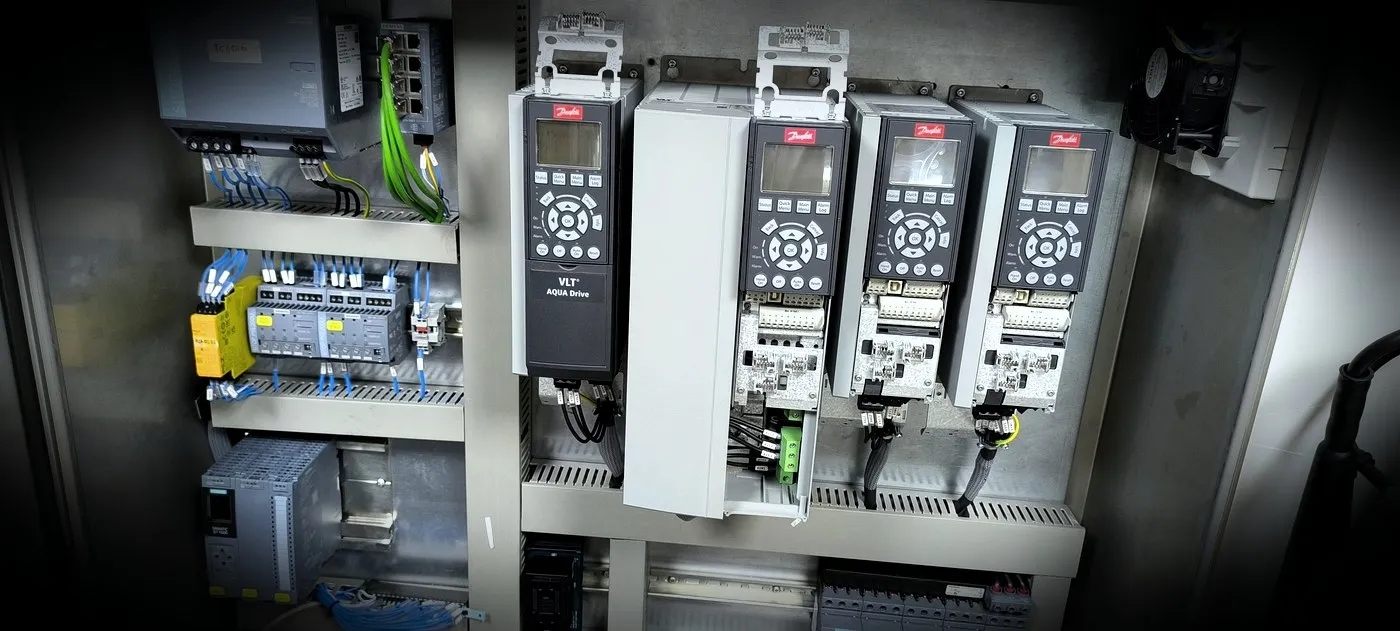
The question we get asked most
“Will the FC-102 do the job for my application, or do I need the FC-302?” — and the answer is never trivial. Both belong to the Danfoss VLT family, share a hardware platform and a parameter-setting philosophy, but they are optimized for two different worlds.
Here is the summary, with no detours.
VLT HVAC Drive FC-102 — optimized for HVAC
The FC-102 is the variable frequency drive (VFD) you use when the load is predominantly quadratic (centrifugal pumps, fans) and dynamic response is not critical, in building climate control and ventilation systems. For drinking water, wastewater and irrigation, the specialist in the family is the VLT AQUA Drive FC-202. The strong points of the FC-102:
- Dedicated HVAC functions: fire mode, anti-jamming ramp, pressure-drop compensation, cascade sequencer.
- V/Hz + VVC+ control profile tuned for affinity curves.
- Dynamic braking is rarely critical (which is why it does not always come with a chopper).
- A more competitive price for equivalent functionality.
VLT AutomationDrive FC-302 — optimized for control
The FC-302 is your drive when the process demands torque control, dynamic response or speed accuracy. Its differentiators:
- Flux Vector Control (FVC) algorithm, with or without encoder. Speed accuracy of 0.01% with encoder.
- Supports PMSM and SynRM synchronous motors in addition to asynchronous induction motors.
- MCO 305 / 351 options for motion control, positioning and synchronization.
- Safe Stop STO as standard (not optional).
- Brake chopper integrated in almost every case.
Quick decision matrix
| If your application is… | Choose |
|---|---|
| Centrifugal pump or fan with varying flow | FC-102 |
| Positive displacement pump or screw compressor | FC-302 |
| Extruder, winder, hoist, crane | FC-302 |
| Commercial HVAC | FC-102 |
| Drinking water plants, wastewater plants, water pumping | FC-202 (VLT AQUA Drive) |
| Chiller with precise PID control | FC-102 (with the advanced control option) |
| OEM machine with synchronized multi-axis | FC-302 + MCO 305 |
| Standard application where price matters | FC-102 |
| Replacement for a high-performance VFD (ACS880, G120) | FC-302 |
The common mistake: “always the FC-302, just in case”
We see projects where the FC-302 is specified for standard pumping applications “in case more functions are needed in the future”. That costs between 15% and 30% more with no operational benefit, and it complicates the parameter setup (more parameters the operator will never use).
The rule is simple: choose according to the real application, not the imagined one. If the application changes in 3-5 years, replacing the whole drive is usually cheaper than buying overkill today.
What we bring from Beiton
Before quoting, our team reviews:
- Type of mechanical load and speed profile.
- The real need for dynamic braking.
- Communications required (Modbus, Profinet, EtherNet/IP, BACnet).
- Environment (IP rating, temperature, altitude, explosive atmosphere).
- RFI filters according to motor cable length.
- Starting vs. rated power (to avoid oversizing).
With that information we deliver the right variable frequency drive selection — without oversizing “just in case” or undersizing to save money.