

“VFD in Panama — price vs. true cost” series · Part 1 of 4
Why this series exists. The Panamanian market filled up with low-cost VFDs: the sticker price came down, but the hidden total cost went up — for the customer, for the electrical grid and for the integrator. The series does not disqualify brands: it lays out the 30+ technical variables that separate a VFD built to last 15 years from one that ends up being an annual consumable, and it arms you with the questions that force any supplier to prove what they are selling.
Map: Part 1 decision framework · Part 2 hardware, harmonics and certifications · Part 3 firmware and algorithms · Part 4 lifecycle and support.
Not every low-cost VFD is a bad buy
New brands, prices 40% to 60% below the traditional manufacturers, immediate availability. The typical reaction from the established distributor is to dismiss them. The customer’s is to buy them without a second thought. Both cost money.
The right question is not “is it good or bad?” — it is which applications does it make sense in, and in which ones will it cost you more than you saved?
You pay for a variable frequency drive twice
The first time is the quote. The second you pay across 10-15 years, in real MTBF, local spare parts availability, technical support at 11 PM on a Sunday, efficiency, and effective service life. None of them shows up on the label; all of them show up in the income statement.
The three axes of the decision
Before comparing brands, answer these:
- How critical the process is — what happens if it stops for an hour, for a shift, for a day?
- Operating hours per year — intermittent (<2,000 h), typical (2,000–6,000 h), or 24/7 (>6,000 h).
- Cost of unplanned downtime — negligible (<US$500/h), painful (US$500–5,000/h), or ruinous (>US$5,000/h).
Decision matrix
| Criticality | Hours/year | Downtime cost | Verdict |
|---|---|---|---|
| Low | < 2,000 | < US$500/h | A low-cost VFD is reasonable |
| Low | 2,000–6,000 | < US$500/h | Low-cost if local spare parts exist for the model |
| Medium | any | US$500–5,000/h | Gray zone — see below |
| High | any | any | Industrial VFD with support and DrivePro |
| Any | > 6,000 | any | Industrial (efficiency alone justifies it) |
| Any | any | > US$5,000/h | Industrial + spare parts on site |
Three real scenarios
Scenario A — Extraction fan in a warehouse
7.5 kW · 1,800 h/year · negligible downtime. → A low-cost VFD is a good buy. If it fails, it gets replaced in one morning. Spending 3× here is over-engineering.
Scenario B — Main pump at a wastewater pumping station
100 HP (≈75 kW) · 8,400 h/year · downtime at US$2,500/h from overflow and environmental fines. → Gray zone. Where most people get it wrong in both directions. There is a specific answer for this range (see the next section).
Scenario C — 24/7 ammonia compressor
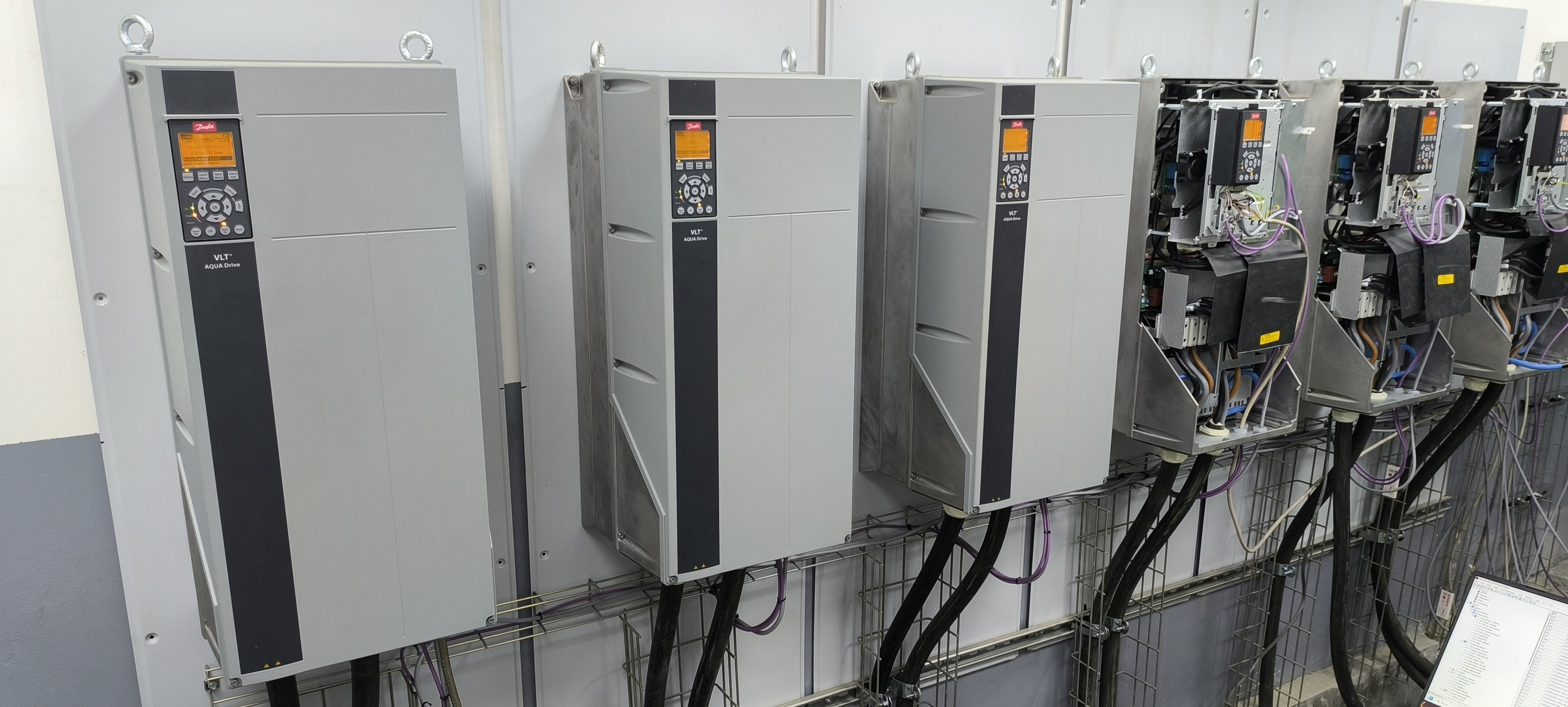
250 kW · the whole cold chain at stake. → Industrial VFD with certified commissioning, spare parts on site and remote monitoring. The 40% saved on the label is lost on the first failure.
The gray zone: when price rules but the application is not trivial
The most common scenario in Panama. The budget is tight, the operator wants a low price, and the engineer knows that if it fails nobody is going to thank him for it.
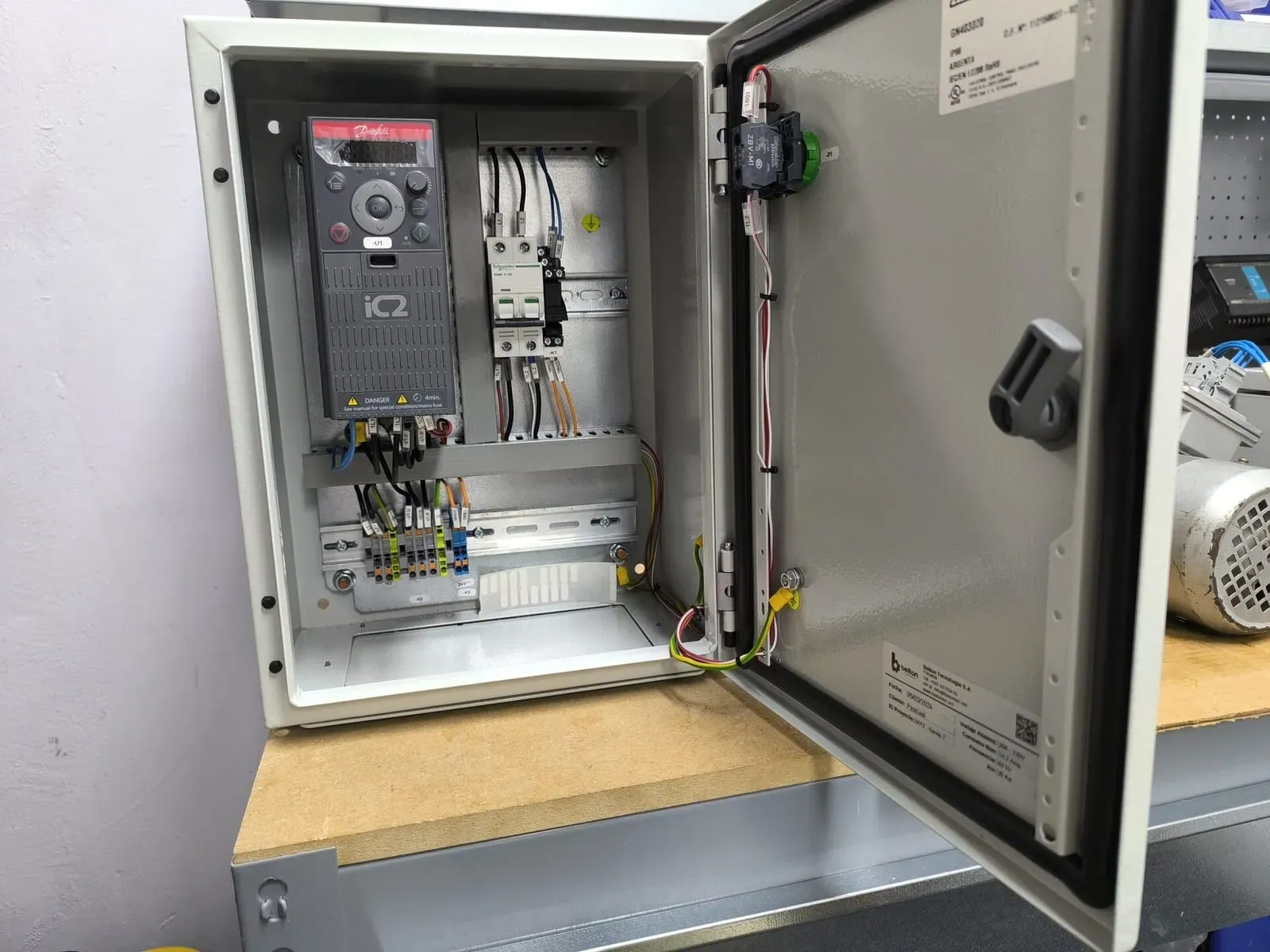
The Danfoss answer is the iC2-Micro: 0.37–22 kW, V/Hz and VVC+, compact architecture — with the difference that changes the equation: local technical support, spare parts in Panama, parameter setup compatible with the VLT family and a factory warranty of 24 months.
It is not an FC-302. But in most of the applications where an entry-level VFD is bought today — utility pumping, general ventilation, light conveyors, screw compressors under moderate load — the iC2-Micro delivers a competitive price with a brand behind it.
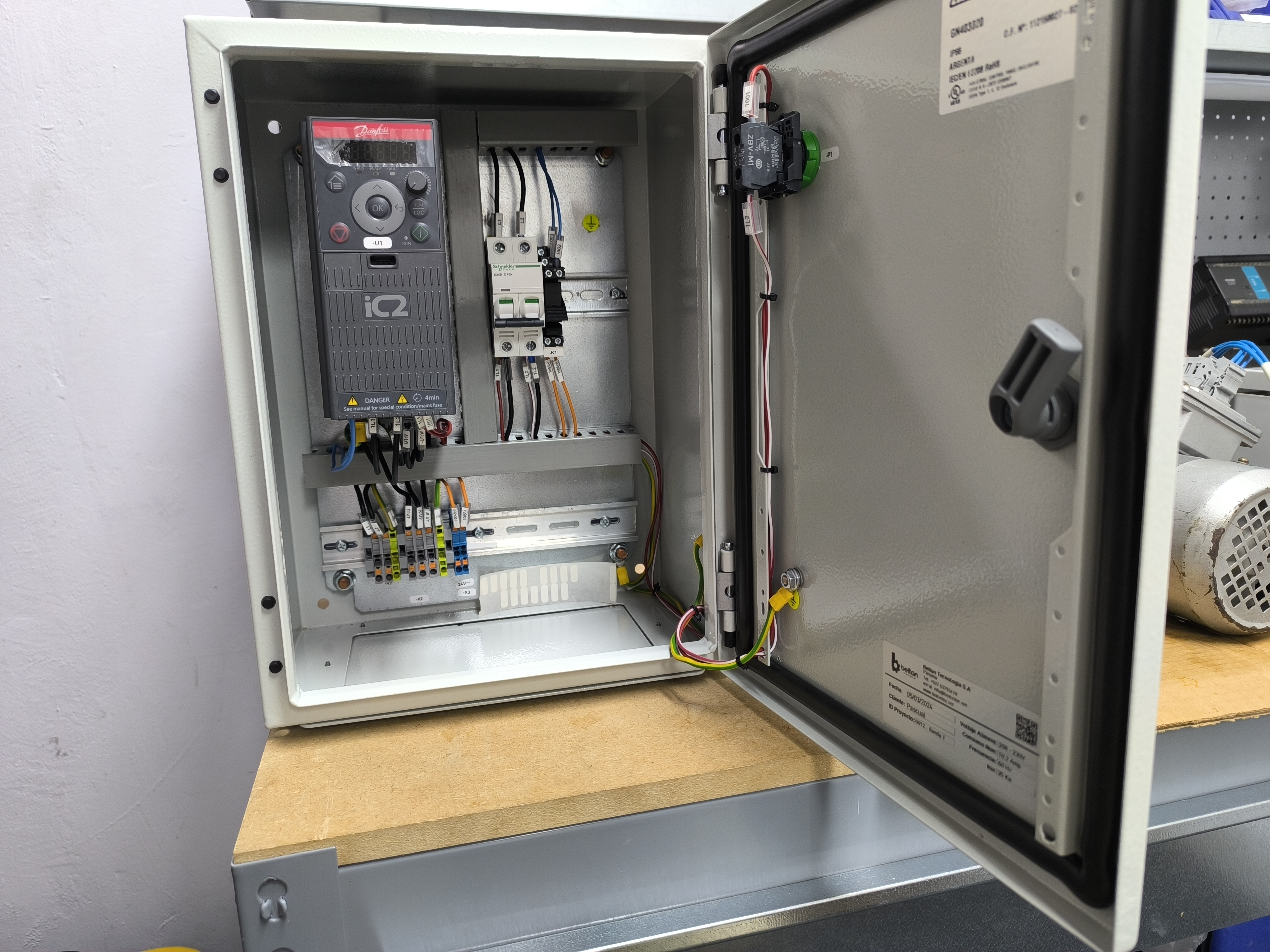
The iC2-Micro is the door, not the whole portfolio
We compete on price with the iC2-Micro, but it is only one piece. We represent the full mature family of Danfoss drives, each one optimized for a range:
- VLT Midi FC-280 — mid range, 10+ years on the market.
- VLT HVAC FC-102 / AQUA FC-202 — pumping, water, HVAC.
- VLT AutomationDrive FC-302 / iC7-Automation — torque control and dynamics.
- iC7 full series — IEC 62443 cybersecurity, efficiency >98% and SiC MOSFET in the iC7-HVACR ULH.
Same parameter setup platform, same software ecosystem, same spare parts commitment. That is a mature platform — and it is what a new manufacturer cannot offer until it has accumulated 20+ years.
Five questions you should demand from your supplier
If you are going for a low-cost VFD, ask for these answers in writing. If your supplier cannot give them, you already know what the low price is worth:
- Spare parts in local stock? Not “we can bring them in 3 weeks” — in Panama, today.
- Technical support SLA — response time, hours of coverage, who answers.
- Factory warranty — 24 months is the serious standard.
- Certifications — CE, UL, IEC 61800-3, IEC 61800-5-1 with a verifiable number.
- Published obsolescence plan — those who do not have one do not publish it.
The conversation starts with three questions
What is the application, how many hours does it run, and what does downtime cost? With those three we get out of the brand debate and into the total cost one. We can get it started in 30 minutes.
If you already know the unit you need, you can check the availability of in-stock Danfoss drives in our online store; the full line we supply is on variable frequency drives in Panama.