

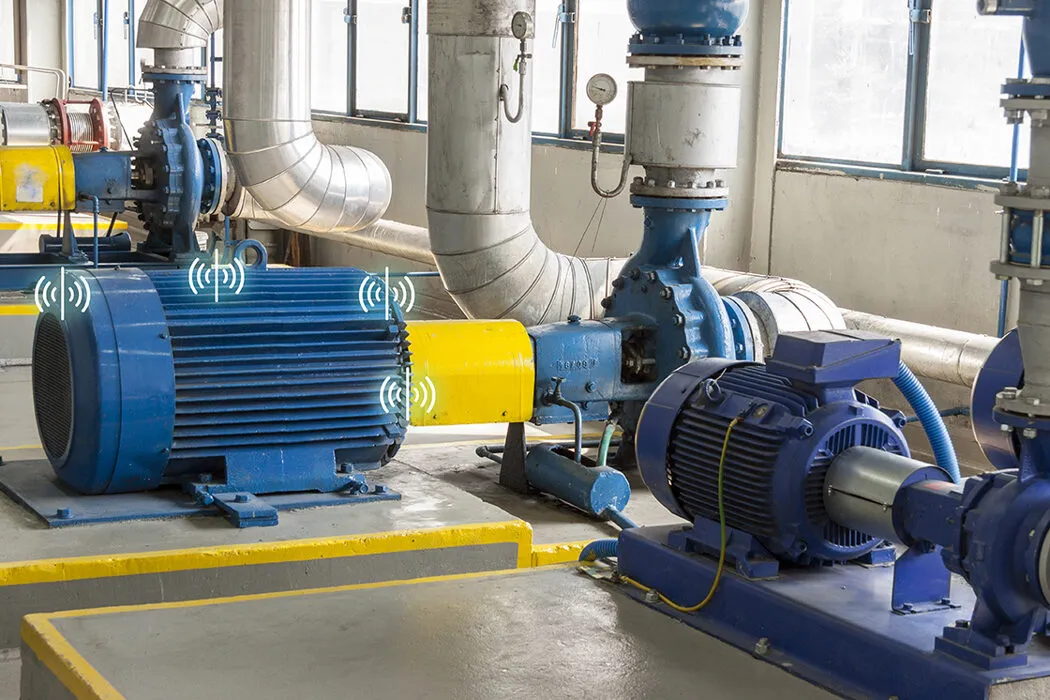
The problem: reactive maintenance in Panamanian industry
Most industrial plants in Panama run on a maintenance strategy that comes down to: “if it works, do not touch it”. When the equipment fails, it gets repaired. When there are no spare parts, something is improvised. When the stoppage lasts days, it is accepted as inevitable.
The real cost of that approach is invisible until it materializes: an ammonia compressor that stops at 2 AM, a production line that loses 8 hours to a bearing that had been degrading for months, a motor that burns out because nobody measured the winding current.
Reactive maintenance costs between 3 and 10 times more than preventive maintenance. And predictive maintenance — anticipating the failure before it happens — is cheaper still.
What Danfoss CBM (Condition-Based Monitoring) is
CBM is a set of monitoring functions embedded directly in Danfoss variable frequency drives (VFDs) that turn the drive into an intelligent sensor. It needs no external hardware for the basic functions: the drive uses its own current transducers and processing algorithms to detect anomalies in the motor and in the application.
This is real edge computing: the algorithms run inside the drive, not in the cloud. Data is processed locally with zero latency, and alerts are raised in real time.
The 6 Danfoss CBM functions
1. Motor Stator Winding Monitoring
The drive analyzes the motor current signature to detect turn-to-turn short circuits in the stator winding — the most common cause of catastrophic failure in industrial electric motors.
What it detects: insulation degradation, partial short circuits between turns.
Why it matters: a motor with a partial short circuit can keep running for weeks, but with progressive overheating. If it is not detected, it ends in an emergency rewind that costs twice as much and stops production.
2. Vibration (up to 4 channels)
With vibration sensors wired to the drive’s analog inputs (4-20 mA), the drive performs vibration analysis correlated with motor speed. That is the key point: vibration at 30 Hz does not mean the same thing as vibration at 50 Hz.
What it detects: unbalance, misalignment, mechanical looseness, bearing wear, resonances.
Advantage over a handheld vibration meter: continuous 24/7 monitoring, not a one-off measurement every 3 months.
3. Load Envelope (Torque Monitoring)
The drive compares the current load profile against a baseline recorded when the system was in good condition. Any progressive deviation points to mechanical wear.
What it detects: impeller wear in pumps, belt degradation, partial blockages, increased friction from lack of lubrication.
A real example: in a centrifugal pump, a gradual rise in torque at the same speed indicates impeller wear or sediment buildup.
4. Bearing Wear
Through current signature analysis (MCSA — Motor Current Signature Analysis), the drive can detect bearing deterioration without external vibration sensors.
How it works: bearing faults generate specific current modulations that the drive identifies through an FFT (fast Fourier transform).
5. Cavitation Detection
For pumping applications, the drive detects cavitation in real time by analyzing the current fluctuations characteristic of the phenomenon.
Why it matters: cavitation destroys impellers in weeks. Detecting it early makes it possible to adjust the speed or the suction pressure before there is damage.
6. Sine-Wave Filter Monitoring
A function introduced in 2025. The drive monitors the health of the output sine-wave filters, detecting degradation before they fail and leave the motor unprotected.
Danfoss drives with CBM built in
Not every drive includes CBM. The families with full support are:
| Drive | Typical application | CBM |
|---|---|---|
| VLT HVAC Drive FC-102 | HVAC, pumping, ventilation | Full |
| VLT AutomationDrive FC-302 | Industrial processes | Full |
| iC7 Series | New generation, IoT | Full + AI edge |
| VACON NXP | High performance, regenerative | Full |
| VACON 100 | Pumps, fans, water | Full |
The iC7 goes one step further, with artificial intelligence algorithms that run directly in the drive for more sophisticated anomaly detection.
CBM + DrivePulse: the complete loop
The CBM functions generate high-quality data from the drive. But data without context is not useful. That is where DrivePulse, our own platform, comes in.
The flow is:
- CBM in the drive raises alerts and condition metrics
- DrivePro Remote Monitoring collects the data over connectivity
- DrivePulse integrates it with the rest of the plant variables (UWT levels, Novus temperature, Samson valves, power quality)
- Our engineers interpret the trends and schedule the actions
The result: a unified dashboard where the maintenance manager sees the status of every asset on a single screen, with prioritized alerts and recommended actions.
A typical case: a processing plant with 15 drives
A plant with 15 Danfoss drives controlling compressors, pumps and fans. Without CBM:
- Reactive maintenance every time something fails
- 3-4 unplanned stoppages a year
- Average cost per stoppage: $5,000 - $15,000 (spare parts + labor + lost production)
With CBM + DrivePulse:
- Early detection of bearing degradation (months before the failure)
- Cavitation detected and corrected in hours, not weeks
- PM scheduled in low-production windows
- Reduction in unplanned stoppages: up to 70%
How to start
You do not need to replace your whole fleet. The Beiton approach is gradual:
- Site Assessment — we evaluate your plant and identify the critical assets
- CBM enablement — we switch on the functions in the drives that already have them (many customers do not know their FC-302 has CBM disabled)
- DrivePulse integration — we connect the data to our platform
- Active monitoring — our engineers interpret the trends and schedule the actions (remote monitoring service)
If you have Danfoss VLT or VACON drives in operation, chances are you already have CBM available. It only has to be turned on.
Want to find out whether your drives have CBM available? Talk to a Beiton engineer for an assessment with no commitment.