

Why IEEE 519-2022 matters in Panama today
The spread of variable frequency drives (VFDs), UPS units, rectifiers and other non-linear loads across Panamanian industry has quietly raised harmonic distortion levels at service entrances. In Panama, what the distribution utility applies is the ASEP Distribution and Commercialization Regulation: its Title IX sets limits on harmonic current emissions (the IDAI and IDAT indicators) referred to the contracted current. IEEE 519-2022 is the good-practice technical reference —the one worth adopting internally— to assess whether the plant is injecting harmonics into the public grid and to design the mitigation.
The most visible change in the 2022 revision over the 2014 one is in even harmonics; the evaluation methodology stays the same:
- Even current harmonics: in 2014 they were limited to 25% of the odd-harmonic limit; in 2022 the limit is 50% for h ≤ 6 and 100% for h > 6.
- Statistical evaluation, unchanged in substance: you measure at least 7 consecutive days at 10-minute resolution and compare the limits against percentiles of those records.
TDD vs. THD — the most common error we see in reports
A frequent confusion in local audits is treating current THD as if it were the compliance metric. It is not. IEEE 519 assesses current in TDD (Total Demand Distortion), which normalizes distortion against the maximum demand current (IL), not against the instant of measurement.
The practical consequence: if your process runs at 30% load while the measurement is taken, THDi can look alarming (50-80%) when the TDD referred to actual demand is in fact within acceptable ranges. A report that does not tell the two apart ends up driving the wrong investment decisions — filters bought that were never needed or, worse, filters left out that were.
The three scenarios where we recommend an audit
- You are getting unexplained variable frequency drive trips. If your VFDs stumble on overvoltage or precharge faults with no apparent cause, the first suspects are transient events or harmonics on the bus.
- You are about to add significant non-linear load. Before adding 200 kW of rectification to your substation, it is worth measuring the baseline.
- You are designing mitigation. Jumping straight to buying passive or active filters without measuring first usually costs 2-3x what it should.
What a well-executed audit delivers
A useful IEEE 519-2022 report is not a PDF with 80 charts and no interpretation. It has to answer:
- Does the plant meet the voltage limits (Table 1) and the current limits (Table 2)?
- What K-factor does the present transformer require, and what will the future one need?
- Which voltage events (sags/swells) fell outside the ITIC curve, and how often?
- How much energy is being lost in cables and transformers to harmonic Joule heating?
- Is the optimal solution a passive filter, an active filter, an AFE-VFD or a combination of them?
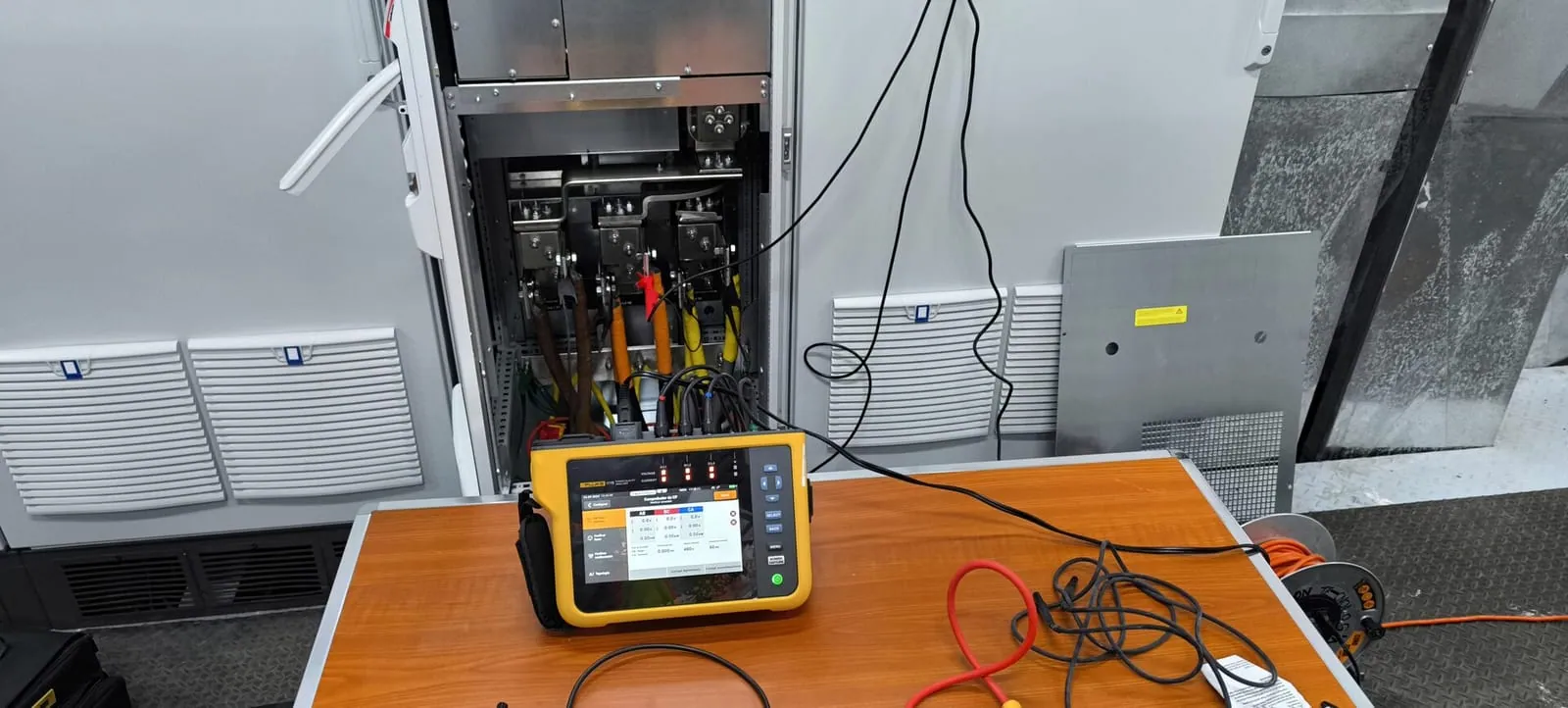
These questions call for Class A instrumentation (IEC 61000-4-30 Class A), not a multimeter “with a harmonics function”. On our projects we use Fluke 1770/1775/1777 analyzers, Class A per IEC 61000-4-30.
When to call Beiton
If you recognize any of the three scenarios above, or you simply want a baseline that documents the current state of your plant, write to us. We run the study in 7 calendar days, deliver the full report in Word + PDF and support you through the selection of mitigation if it turns out to be needed.
If you already have a measurement exported from your Fluke analyzer, you can send it to our free power quality check and get the report at no cost. For a full on-site study, see IEEE 519 power quality in Panama.