

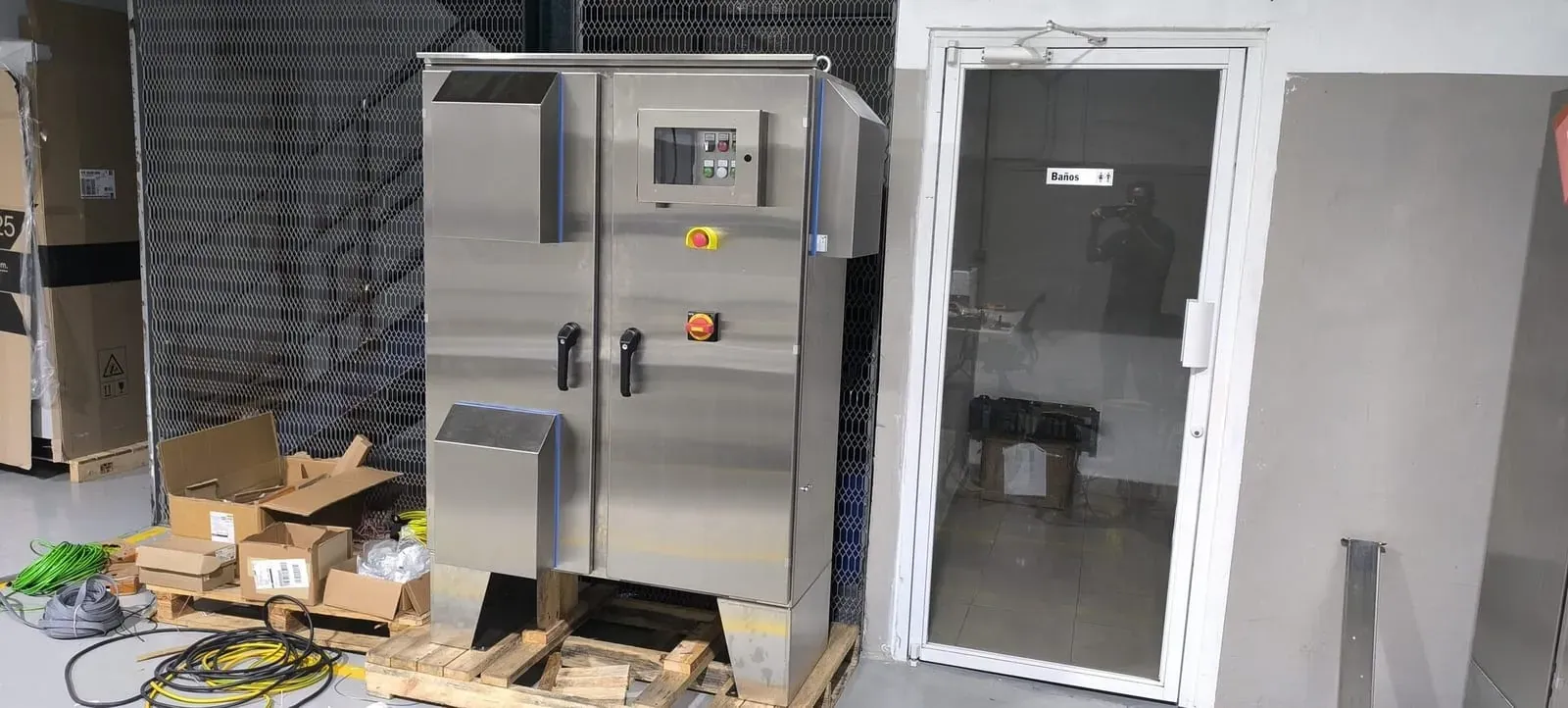
The panel looks great on day one
A badly built control panel looks identical to a well built one the day you hand it over. Clean paint, aligned door, new labels, LEDs lit. The difference shows up three or five years later: corrosion inside, welded contactors, a thermostat that never triggered the fan, and a power cable routed too close to a communication bus.
This guide sums up what a properly built industrial panel must have — and the five mistakes we see most often in technical audits in Panama.
At a glance
| Standards that apply in Panama | Panama’s RIE (based on the NEC, Art. 409 for industrial control panels) · UL 508A (USA) · NEMA 250 · IEC 61439 (when the client specifies it) |
| Enclosure materials | Painted galvanized steel · 304/316 stainless steel · Reinforced polyester |
| Typical protection degrees | IP54 industrial indoor · IP65 outdoor · IP66 hose-down washing · NEMA 4X corrosive |
| Voltages handled | Control 24 VDC / 120 VAC · Power 208–480 VAC · Medium voltage > 1000 VAC |
| Mandatory deliverables | Single-line diagram · bill of materials · mechanical drawings · as-built · FAT certificate |
1. Panel anatomy: the 5 compartments
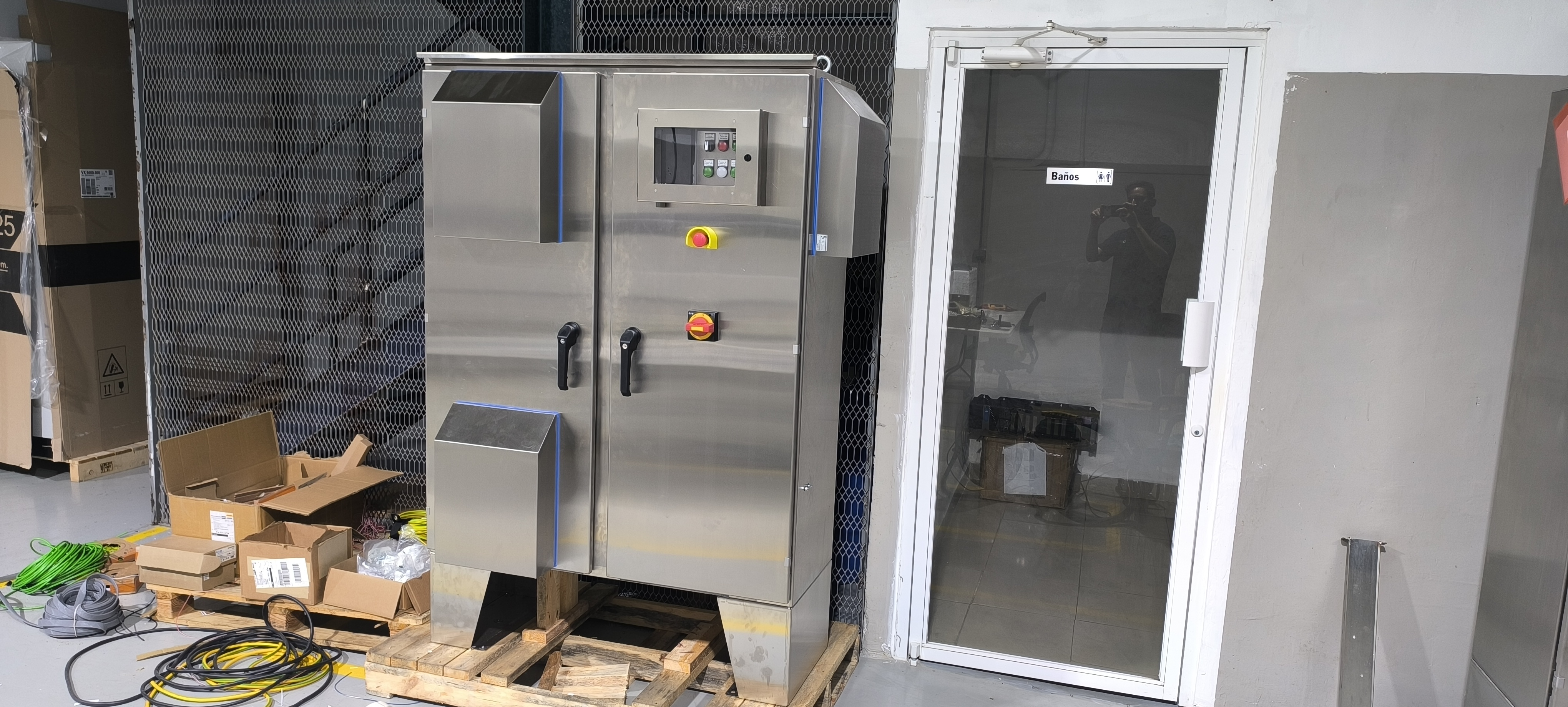 Control panel in 316L stainless steel with HMI, emergency pushbutton and selector switches. IP55 enclosure ready for a marine or sanitary environment.
A typical industrial panel has five functional compartments. They may be physically separated (large enclosures with barriers) or share a compact enclosure, but logically they always exist:
Incoming compartment (service entrance)
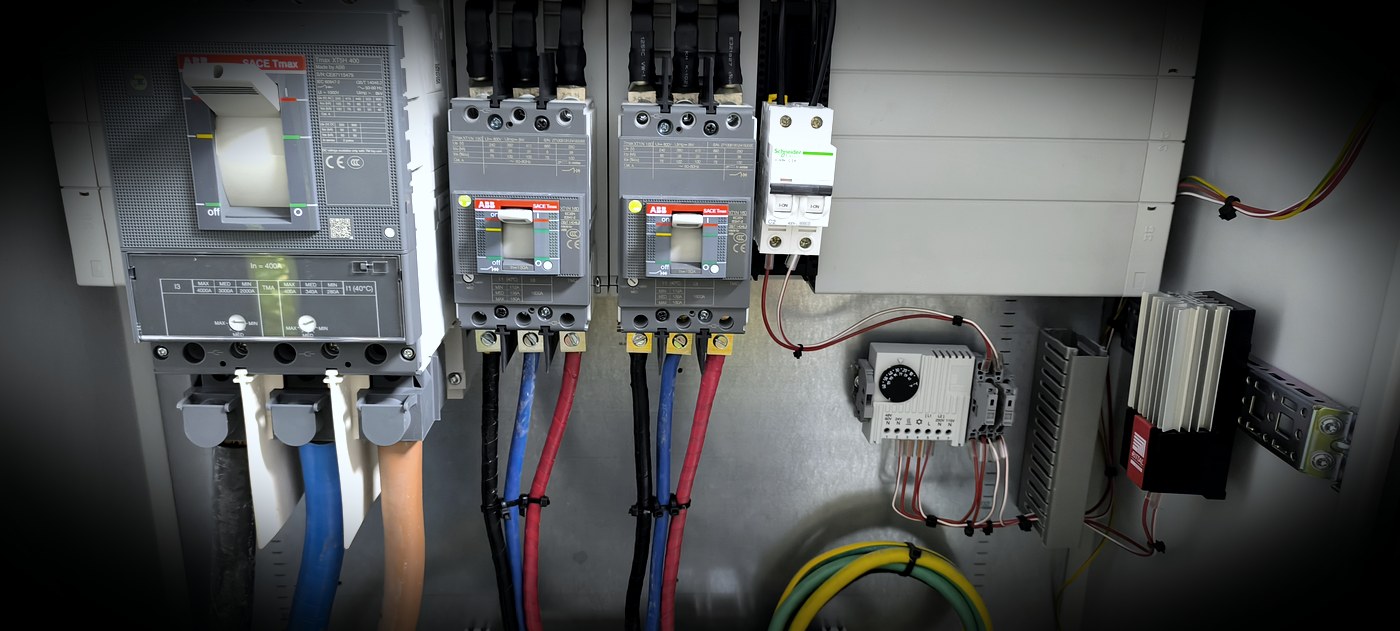 Service-entrance compartment: ABB SACE main breaker + distribution breakers. Insulated cables neatly routed to the busbars.
Utility power comes in (service-entrance cable, busbars), passes through a main breaker with a breaking capacity matched to the short-circuit current at that point (Icc in kA), and is distributed to branch breakers or fuses. This is where the surge protective device (SPD), the metering current transformers and the protection relays live.
Power compartment
Contactors, thermal overload relays, drives (variable frequency drives (VFDs) and soft starters), motor circuit breakers. This is the area where currents are high and the dissipated heat is significant. It calls for forced ventilation or air conditioning sized to the sum of the internal losses.
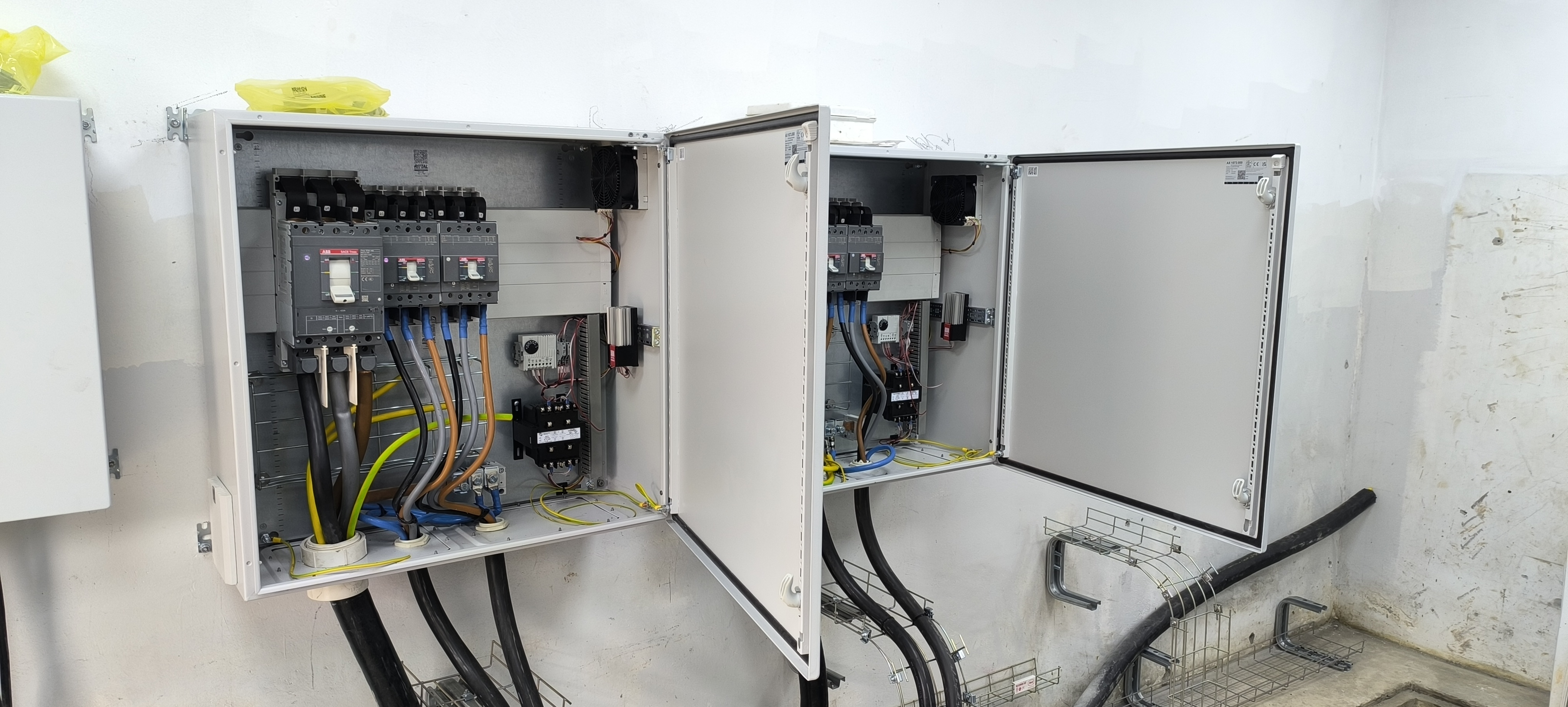 A pair of power panels installed in the plant — pump feeders. Power cables below, control above, segregated from each other.
Control compartment
PLC, HMI, 24 VDC power supply, I/O modules, interface relays. It works with low-voltage signals and digital communication. It is physically separated from the power compartment to avoid electromagnetic coupling that injects noise into the sensor readings.
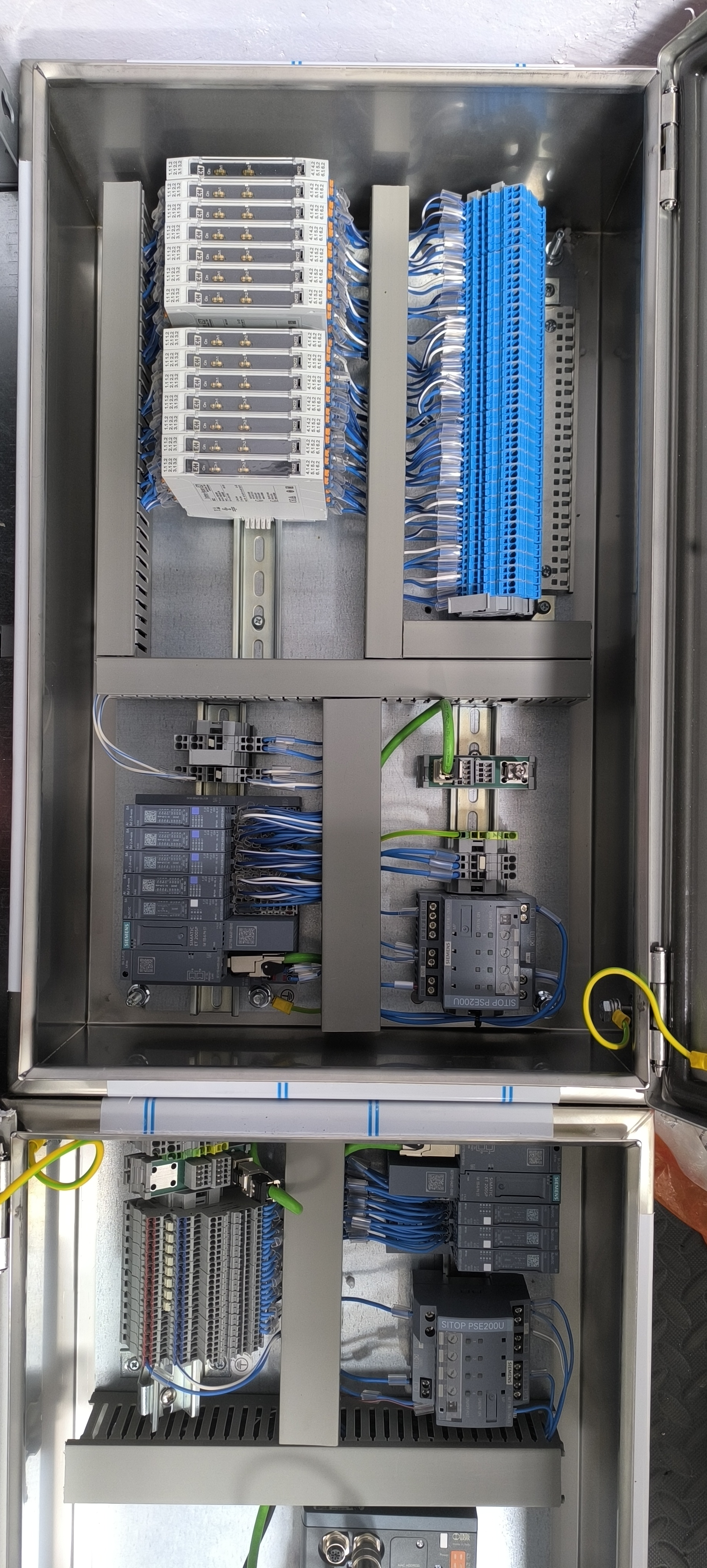 Control compartment: Siemens S7-1200 CPU, I/O modules, numbered terminal blocks and Profinet communication cable.
Drive compartment
When there are VFDs or soft starters, they get their own space with dedicated ventilation (drives are the panel’s main heat source). The harmonic filter also goes here where one applies.
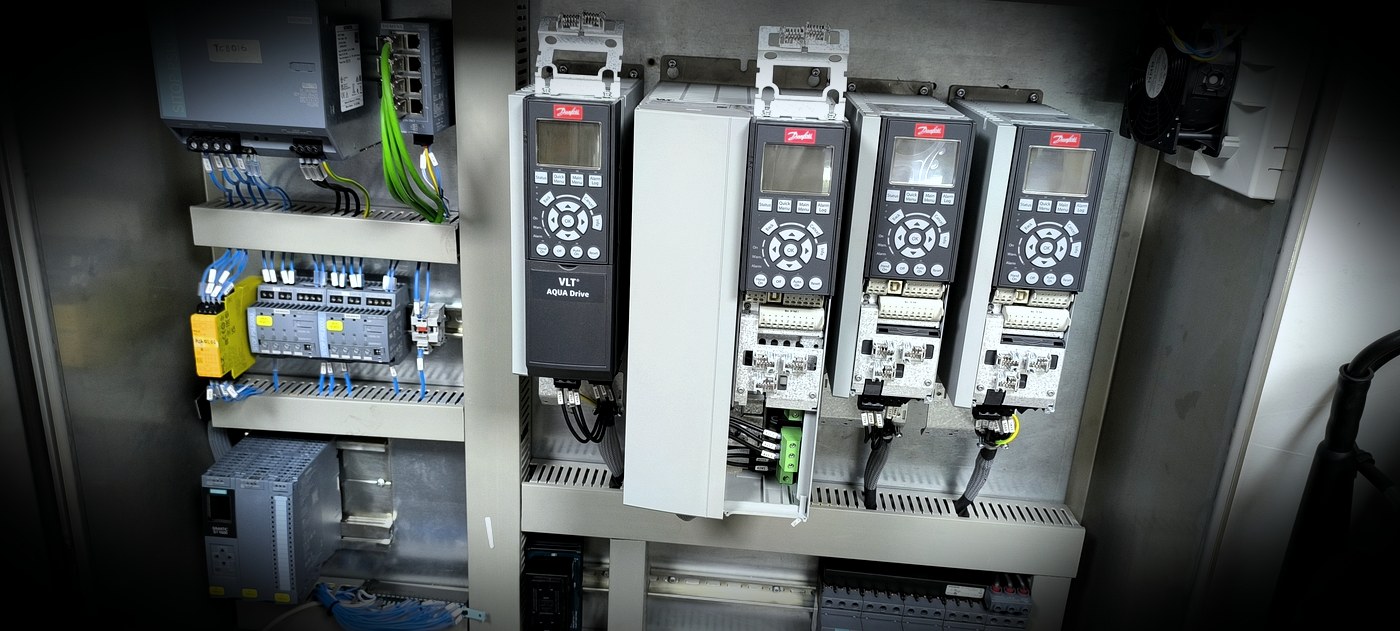 Danfoss VLT Aqua drives in a wastewater treatment plant panel. Top: Siemens PLC + safety relay. Bottom: motor circuit breakers and bypass contactors.
Field compartment (terminal blocks)
Every signal going out to the process (sensors, instruments, valves, motors) lands on numbered terminal blocks before it is connected to the PLC or to the drives. It is the boundary of the panel — and the point where most faults are either solved or created during commissioning.
2. Enclosure materials: when to choose what
The enclosure material is selected on the environment, not on the budget. Using galvanized steel where 316 stainless belonged is the most frequent mistake, and the most expensive one over the medium term.
| Material | When to use it | When NOT to |
|---|---|---|
| Painted galvanized steel | Clean indoor space, climate-controlled electrical room, IP54 | Close to the coast, hose-down washing, chemical environment |
| 304 stainless | Chlorine-free food processing, humid indoor space, outdoors away from the coast | Chloride environments (marine, swimming pool, CIP with hypochlorite) |
| 316 / 316L stainless | Marine environment, water treatment plants, processes with chlorides | — |
| Reinforced polyester / GRP | Aggressive outdoor sites, coastal locations, areas with electrical vandalism | Environments with high radiant heat or a strict EMC requirement |
Panama: a rule of thumb
- Panama City, industrial area, climate-controlled room → painted galvanized IP54 is fine.
- Colón, Panamá Pacífico, Amador, the coast → 316 stainless or GRP, IP65 minimum.
- Wastewater treatment plant, food plant with washdown → 316L stainless, IP66, no penetrations on the top face.
3. Certifications: what to ask for and when it matters
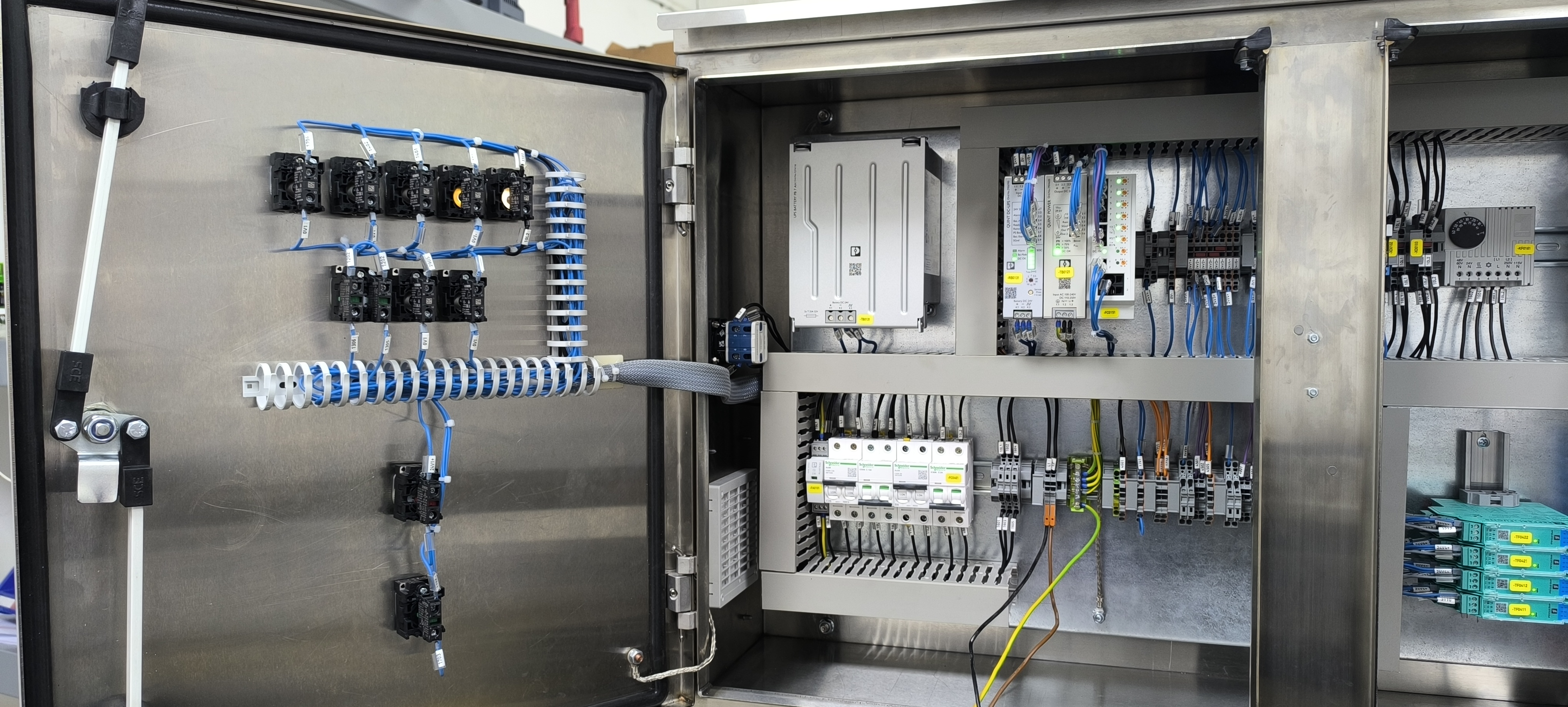 Wiring color-coded by function, numeric labeling per terminal and separate wireways for power/control/communication. A UL 508A requirement.
UL 508A — Industrial Control Panels
The reference certification in North America. It applies when:
- The customer is a multinational with a US corporate standard (Amazon, Walmart, Nestlé Purina, Mars, global pharma).
- The project exports to the USA or Canada.
- The insurer requires it for the industrial policy.
UL 508A covers SCCR (Short-Circuit Current Rating), circuit separation, approved materials, marking and documentation. A labeled UL 508A panel has full traceability — every component is UL-listed and the assembly is audited.
IEC 61439 — the international standard
The European and international equivalent. It replaces the former IEC 60439. It applies to projects under European codes, in other Latin American countries (Colombia RETIE, Chile SEC, Mexico NOM-001-SEDE) and to plants belonging to European multinationals (Siemens, Bosch, BMW). In Panama the RIE governs, based on the NEC; IEC 61439 applies when the client or the parent company specifies it.
NEMA 250 — degree of protection
NEMA is the North American equivalent of IP. A practical equivalence table:
| NEMA | IP equivalent | Typical environment |
|---|---|---|
| NEMA 1 | IP10 | Clean indoor |
| NEMA 12 | IP54/55 | Industrial indoor with dust |
| NEMA 4 | IP66 | Outdoor, water washdown |
| NEMA 4X | IP66 + corrosion | Coast, food, pharma |
| NEMA 7 / 9 | Ex-proof | Classified areas (gas / dust) |
4. Ventilation and cooling: the calculation nobody gets right
In our experience, most premature panel failures in Panama are thermal. The panel is not sized for the heat it produces — it is sized so the equipment physically fits.
The correct calculation starts from the sum of the losses (W) of every internal component at full load:
- Control transformer → ~3–5% of its kVA
- Contactors → 1–5 W per pole depending on size
- VFD → 2–4% of the rated kW (the largest source)
- DC power supply → 5–10% of its rated W
- PLC and comms → < 50 W in total, typically
With the total dissipation calculated and the maximum external ambient temperature (in Panama, take 40 °C in the shade as the design figure), you size:
- Natural ventilation (filtered vents) — enough if ΔT < 10 °C.
- Forced-air fan — up to ΔT ~15 °C.
- Panel air conditioner — when ΔT > 15 °C, or when the environment carries dust or humidity that the filter does not stop.
In Panama, a panel with a VFD above 30 kW in a room with no climate control almost always needs a panel air conditioner. Ignoring this cuts the service life of the drives in half.
5. The 5 mistakes you pay for 5 years later
-
Galvanized where stainless belonged. “It is inside the electrical room.” At 3 years, condensed humidity + dust + salt air corrode the busbars and the ground faults start. By then, replacing the panel costs more than building it in stainless from the start.
-
Power and communication cables in the same wireway. It works on day one. Six months later, the PLC starts seeing erratic readings from the encoder or from the analog sensor. It is EMI coupling — it takes physically separate wireways and correct shielding.
-
SCCR not calculated. When the inspection or the auditor arrives, they ask for the short-circuit current calculation at the installation point. If the panel does not withstand that Icc, it is rejected. The cost of the retrofit is higher than choosing components with enough kA from the start.
-
No as-built after modifications. The panel leaves the shop with impeccable drawings. During commissioning three wires get moved, two terminal blocks get changed, one contact gets added. Nobody updates the drawing. Five years later, when there is a fault, the next technician loses two days deciphering the real wiring.
-
Thermostat and fan with no periodic test. The fan gets dirty, the thermostat drifts. Nobody notices until the VFD shuts down on over-temperature at the worst possible moment. The annual PM on the panel must include filter cleaning, an airflow test and verification of the thermal setpoint.
6. How Beiton builds a panel
When Beiton designs and builds a panel, the flow is:
- Detailed engineering — single-line diagram, bill of materials, mechanical layout, thermal calculation, SCCR calculation, control diagrams.
- FAT (Factory Acceptance Test) — functional testing with the customer present (virtually or in person) before shipment. I/O simulation, sequence verification, insulation, continuity.
- SAT (Site Acceptance Test) and commissioning — field integration, drive parameter tuning, PLC configuration, handover of the as-built package.
- Warranty and PM — post-commissioning follow-up, an annual review with a thermal check, cleaning and recalibration.
Every Beiton industrial control panel is delivered with an auditable documentation package (drawings, BOM, FAT, material certificates, manuals).
Next step
If you have a project where you are about to bid out a control panel, or you have panels installed with no as-built package and no formal PM, we can help you specify the scope correctly. We send a technical and commercial proposal with engineering included, the applicable certifications and the lead time.
For fleets of VFDs integrated into existing panels, we combine the work with DrivePro Services to keep the whole ecosystem under a single contract.