

At a glance
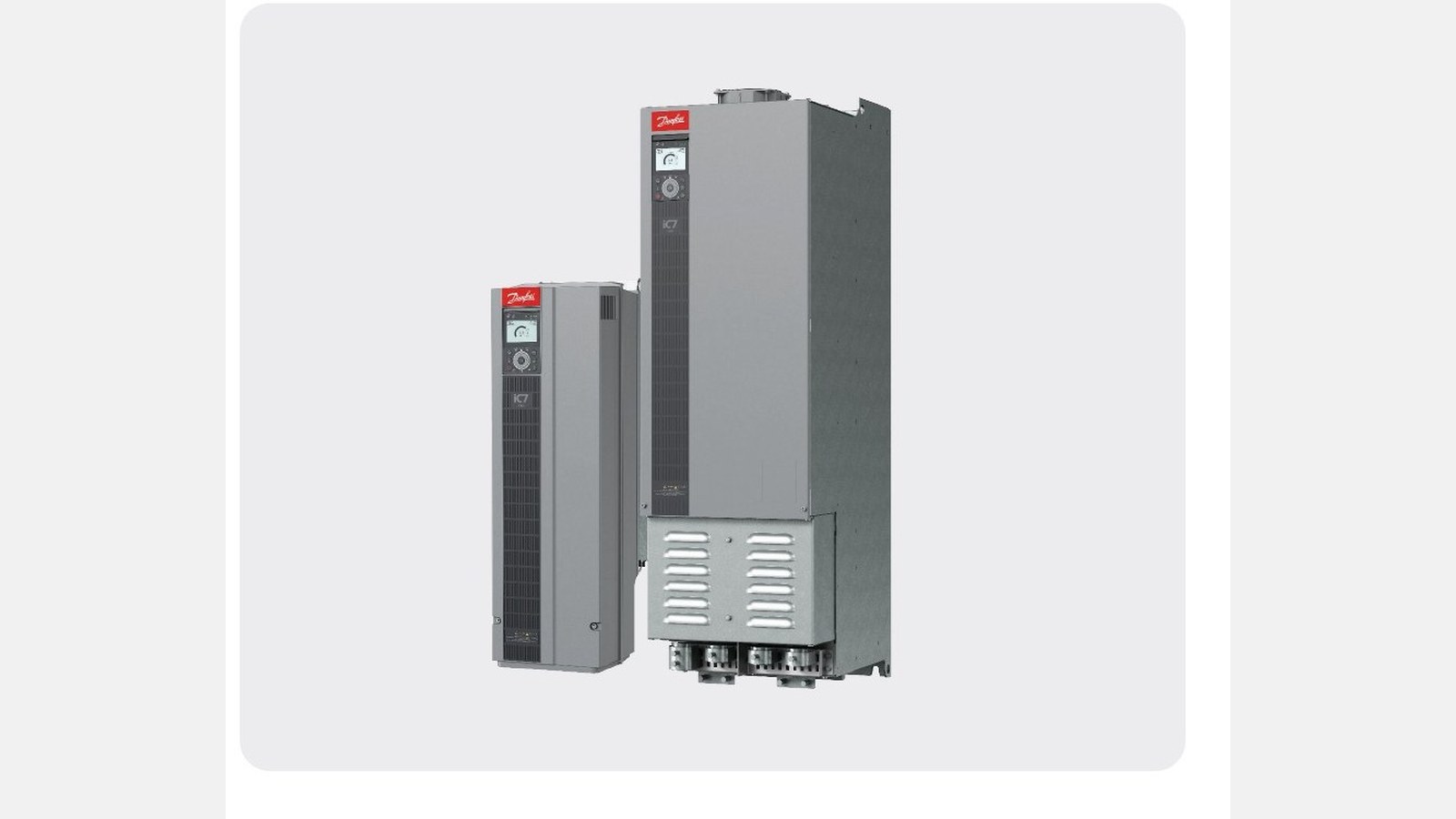
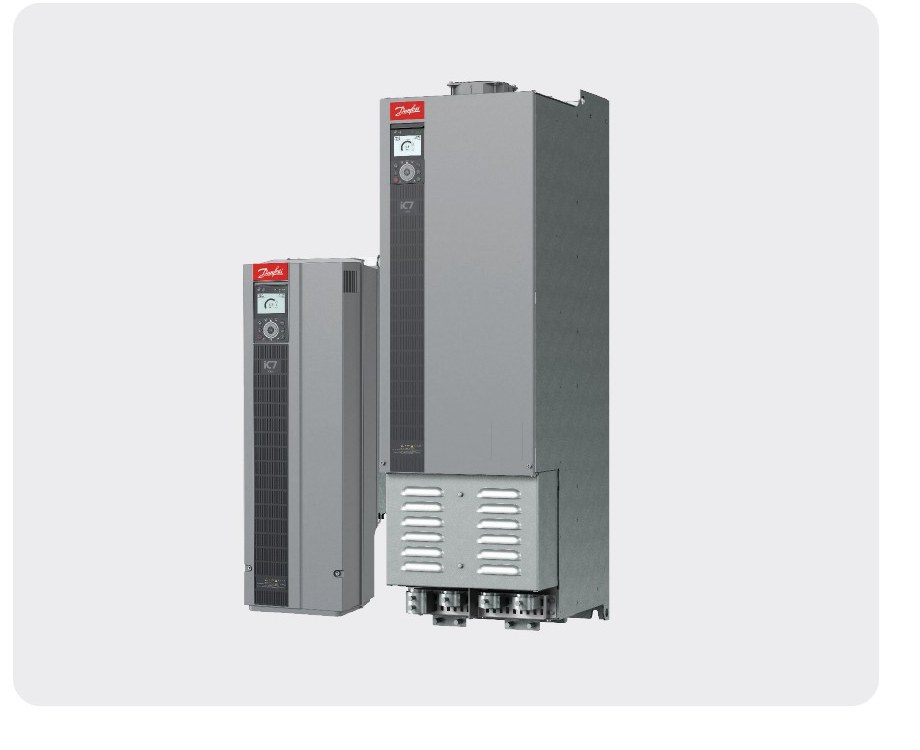
The Danfoss iC7-HVACR ULH packs the complete answer to harmonics in HVACR systems into a single enclosure (3 input cables, 3 output cables). It needs no external AHF or AAF. It needs no oversized transformer. It needs no capacitor bank.
| Parameter | Value |
|---|---|
| THDi at full load | < 3% |
| THDi at 50–90% load | < 5% |
| Power factor | 1.0 |
| Power range | 22 – 160 kW (30 – 250 HP) |
| Compliance | Built-in IEEE 519-2022 |
| Typical application | Chillers, AHUs, cooling towers, secondary pumps |
1. The problem it solves
On any HVACR project in Panama with a significant variable frequency drive (VFD) load, the pattern repeats itself: the right drive is selected for the pump or the fan, it is energized, and current distortion at the point of common coupling (PCC) exceeds the IEEE 519-2022 limit. That limit is set on TDD and ranges from 5% to 20% depending on the Isc/IL ratio: 5% only applies to weak grids (Isc/IL < 20).
The traditional options add cost, losses and complexity:
- External active filter (AAF) → high cost, extra enclosure, maintenance of its own.
- Advanced passive filter (AHF) → losses of 2–3% of rated power, tuning fixed to one frequency.
- Oversizing the transformer for K-factor → permanent additional CAPEX.
- 18-pulse rectifier → requires a three-winding transformer.
None of them is elegant. All of them leave a trace. In a plant with drives already installed, a harmonic filter is still the way to correct it; on a new project, the ULH avoids needing one.
The iC7-HVACR ULH solves the problem from inside the drive. The upstream electrical infrastructure can be sized 10–25% smaller. That CAPEX saving usually pays for the price step up to the ULH drive.
2. What “Ultra Low Harmonic” means
A typical VFD with a 6-pulse rectifier generates 35–40% THDi at full load — far above any TDD limit when those drives make up most of the load. The industry has spent decades mitigating the problem after the fact. The table sums up the options:
| Solution | THDi achieved | Relative cost |
|---|---|---|
| Plain 6-pulse | 35–40% | 1× |
| Line reactor | 25–35% | 1.1× |
| 12-pulse rectifier | 10–15% | 1.5× |
| 18-pulse rectifier | 5–8% | 2× |
| Passive AHF | 5–10% | 1.8× |
| Active AAF | < 5% | 2.2× |
| Built-in AFE (iC7 ULH) | < 3% | 1.9× — with no extras |
The iC7 uses an Active Front-End (multilevel active rectifier): it injects current in phase with the voltage and eliminates distortion at the source. It does not filter it afterward.
3. The technology leap: SiC MOSFETs
The key to the iC7-HVACR ULH is the transistor material. Traditional industrial VFDs use Si IGBT (silicon). The iC7-HVACR ULH uses SiC MOSFET (silicon carbide) — the same technology that gave electric vehicles their efficiency leap.
Lower switching losses
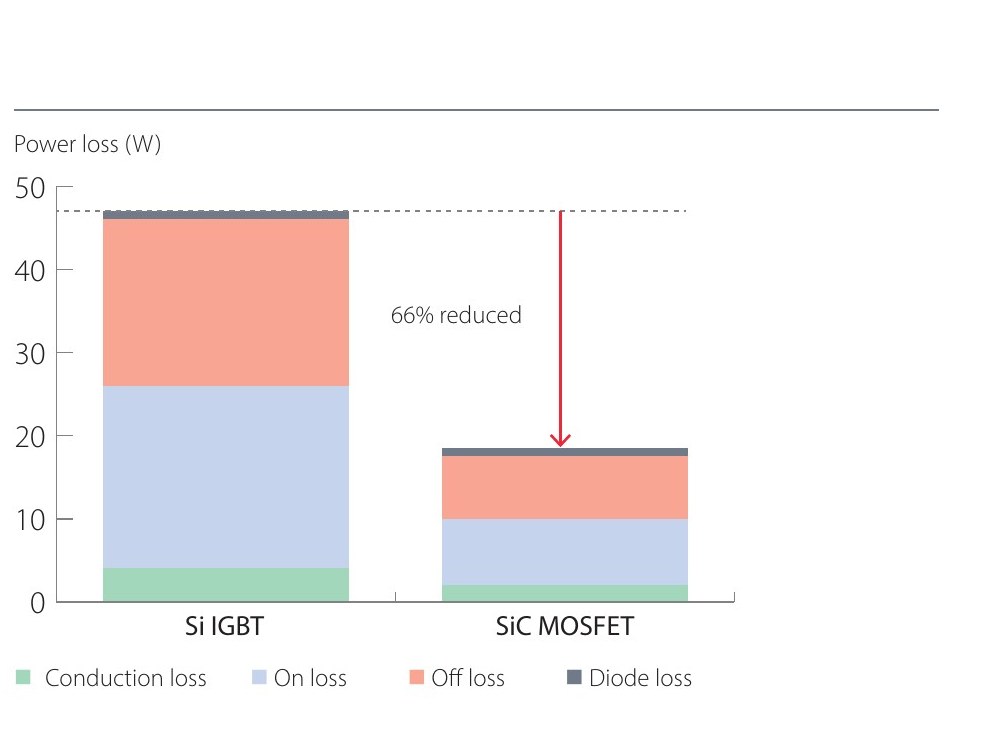
66% lower losses enable two things:
- A higher switching frequency → the input LCL filter is smaller → the complete drive fits in a single enclosure.
- Less dissipated heat → the electrical room needs fewer BTU/h of extraction.
3-level output instead of 2
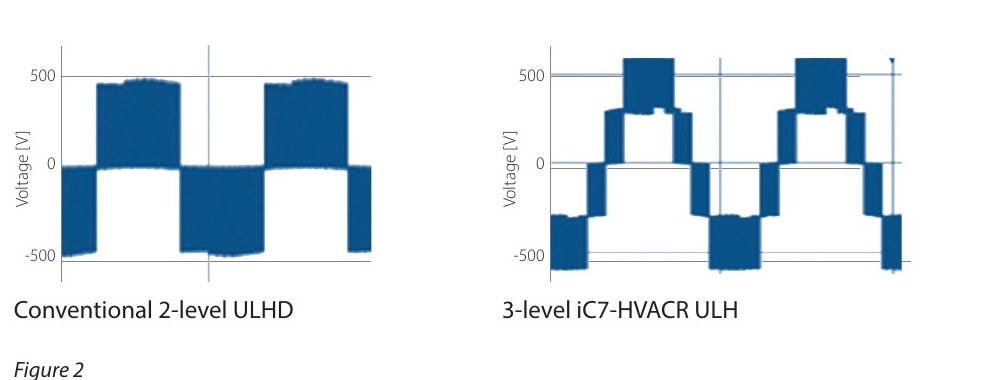
The multilevel topology produces a waveform closer to a sine. That reduces dV/dt on the cable and extends the life of the winding in the motor. Reflections and voltage peaks in installations with long cable runs are damped.
4. Part-load performance
A chiller or an AHU rarely runs at 100%. The real cycle in Panama:
- Early morning and night → 20–40% load
- Working hours → 50–80%
- Peak heat (2–4 PM) → 80–100%
Conventional ULH drives perform well at 100% but their THDi degrades quickly as the load comes down. At 50% they can reach 6–8% — with less margin against the IEEE 519 limits.
The iC7-HVACR ULH holds THDi < 3% at full load and < 5% across the 50–90% range. Through the 16+ hours a day the system runs at part load, the grid stays clean.
5. Five concrete savings on Panamanian projects
Transformers 10–25% smaller
With no significant harmonics, you do not need a high K-factor. A 400 kW HVACR load that used to call for a 630 kVA transformer now needs 500 kVA. The difference in weight, oil and breaking capacity offsets the step up to the ULH drive.
Thinner supply cables
With no elevated harmonics there is no derating factor for the extra heating. Cables are sized as if the load were linear.
No capacitor bank and no detuned reactors
Power factor 1.0 from day one. You do away with the reactive compensation panel and its maintenance.
No power factor or harmonic penalties
In Panama, the utility applies the ASEP regulation: a surcharge when the monthly power factor (calculated from kVArh/kWh) falls below 0.90, and harmonic emission limits referred to the contracted current. With the iC7 ULH there is no technical dispute at the PCC — compliance is by design.
Retrofit with no upgrade to the main panel
For existing plants that want to add VFDs without touching the transformer or the upstream panel, the ULH makes it possible. It enables energy-saving projects (20–50% in variable-load pumps and fans, compared with valve or damper control) that used to be unviable because of the grid.
6. Better reliability on a dirty grid
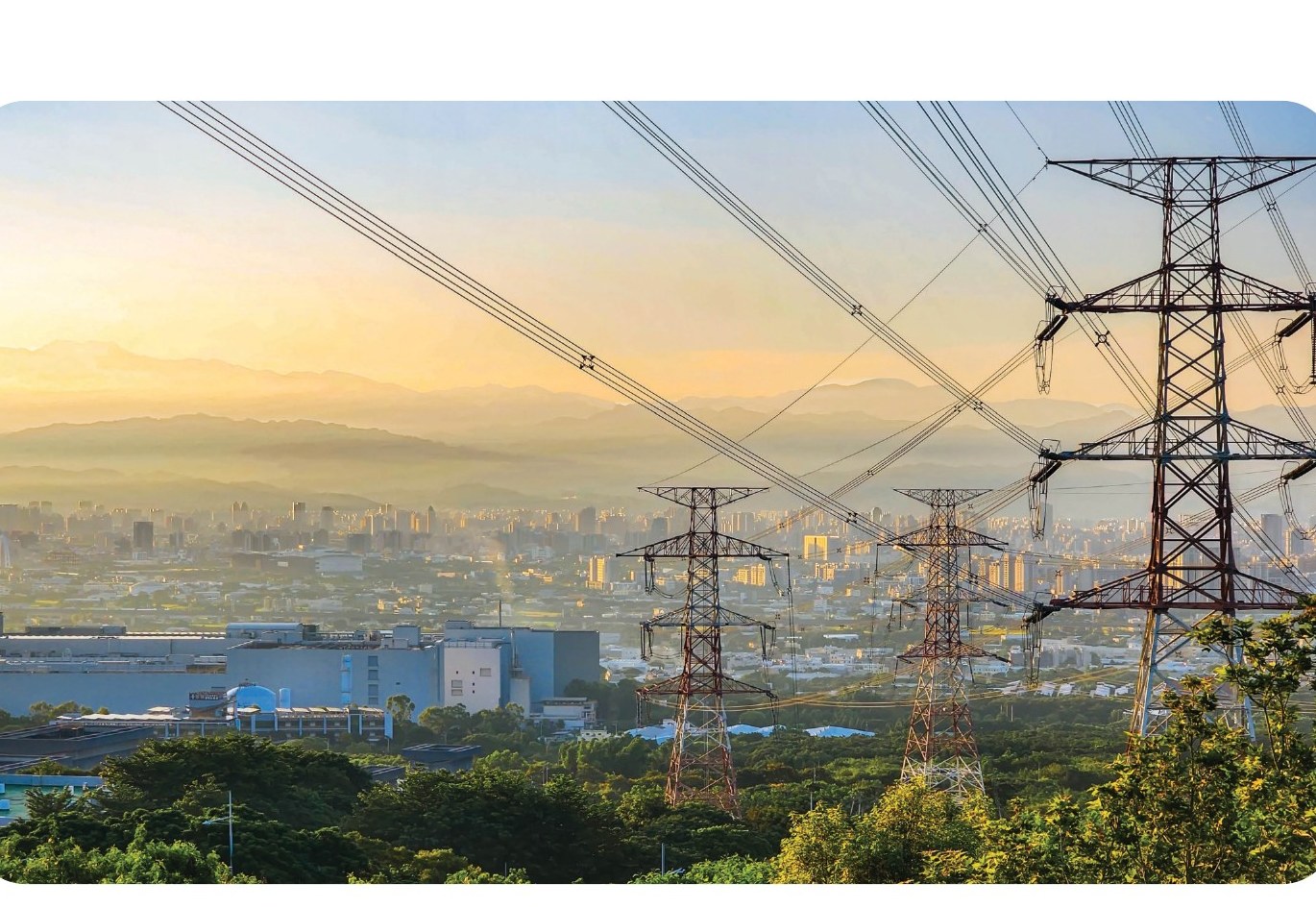
The active rectifier is not only “clean output”: it is also robust input. Faced with voltage dips, brownouts or momentary sags on the grid, the iC7 keeps the load running without tripping.
On top of that, it eliminates common-mode current with a clamping technique that routes it back to the source — it protects the motor bearings against the leakage currents that, in installations with conventional VFDs, are a frequent cause of premature failures.
7. Edge computing + built-in CBM
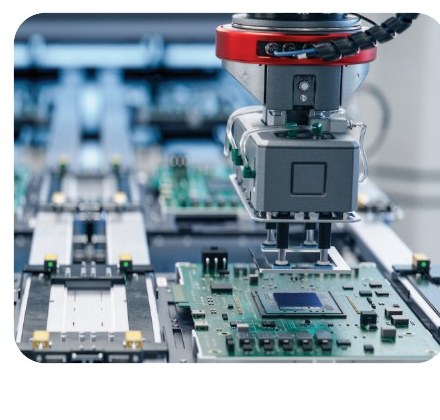
Every iC7 includes embedded Condition-Based Monitoring (CBM):
- Machine learning inside the drive itself establishes the operating baseline.
- It detects variations in load, in motor winding integrity and in bearing wear.
- It raises alerts locally — with no need to send data to the cloud.
This is real edge computing: protection for the motor (fewer unplanned failures) and security (less attack surface, less data leaving the plant).
Combined with DrivePulse, CBM events are consolidated with the full inventory, the PM calendar and service traceability.
8. “Secure-by-design” cybersecurity
In data centers, hospitals, government buildings and airports, BMS cybersecurity is no longer optional. An attack on the HVAC system can:
- Shut down the chillers of a data center → servers overheat.
- Change setpoints in a hospital → risk to patients and to medication storage.
- Destroy equipment by running it out of range.
The iC7 ships from the factory with:
- A cryptographic chip on the control card (hardware, not software alone).
- Encrypted connectivity — TLS on Modbus TCP, EtherNet/IP, PROFINET.
- Tamper-proof hardware — physical opening is logged.
- Signed firmware — only Danfoss can update it.
- Public-key certificates — cryptographic authentication for remote access.
The iC7 platform is designed to IEC 62443-4-2, the standard for cybersecurity requirements of industrial automation components that critical-infrastructure specifications usually cite.
9. Key specifications
Electrical
| Input voltage | 380–480 V AC, −15% / +10% |
| Input frequency | 45–65 Hz |
| Power range | 22–160 kW (30–250 HP) |
| Output current | 43–302 A |
| Output frequency | 0–590 Hz |
| Overload | 110% (pumps, fans); 150% others |
| THDi | < 3% at full load · < 5% at 50–90% |
| Power factor | 1.0 |
| Efficiency class | IE2 (IEC 61800-9-2) |
Environment and mechanics
| Temperature | −30 to 40 °C (up to 50 °C with derating) |
| Altitude | Up to 4,400 m |
| Humidity | 95% non-condensing (3K22) |
| Corrosion | C3 (P1) uncoated / C4 (P2) coated |
| Vibration | 3M12 |
| STO | SIL3, PLe |
Dimensions
| Range | Frame | W × H × D (mm) | Max weight |
|---|---|---|---|
| 22–55 kW | Fx07 | 239 × 770 × 327 | 38 kg |
| 75–160 kW (IP20) | FA10b | 352 × 1186 × 505 | 158 kg |
| 75–160 kW (IP21/54) | Fx10b | 422 × 1239 × 535 | 160 kg |
Communications and I/O
- Embedded Ethernet: Modbus TCP · EtherNet/IP · PROFINET RT / RT-S2 · EtherCAT
- Serial: Modbus RTU
- Others: MQTT · OPC UA (available soon)
- Standard I/O: 2 AI (0–10 V or 0/4–20 mA, Pt1000/Ni1000/KTY support) · 1 AO · 4+2 DI (PNP/NPN selectable) · 2 DO · 2 NO/NC relays, 2 A at 250 V AC
10. Typical applications in Panama
- Data centers — chillers, cooling towers, AHUs. Precise control + IEEE 519 + cybersecurity.
- Hospitals — chilled water pumps, exhaust fans, medical air compressors. 24/7 with no stoppages.
- Hotels — central chillers, circulation pumps, kitchen fans. Savings at partial occupancy.
- Corporate buildings — tenant chillers, AHUs per floor, parking exhaust fans.
- Food and beverage — condensers, ammonia compressors, glycol pumps.
- Cleanrooms — precise flow control + grid compliance.
- Airports and terminals — HVAC for public areas, pressurization.
11. How we quote an iC7-HVACR ULH
To issue the correct type code we need:
- Power and load type — motor HP, application (centrifugal / axial fan, pump, scroll / screw compressor).
- Voltage and frequency — 380, 400, 440, 460 or 480 V; 50 or 60 Hz.
- Ambient conditions — electrical room temperature, humidity, altitude, proximity to the coast.
- Protection rating — IP21 indoors vs. IP54 / IP55 for exposure.
- Communication protocol — the one your existing BMS / SCADA already uses.
- Functional safety — is STO enough, or do you need a safety bus (FSoE / PROFIsafe).
- Drive → motor distance — to define a dU/dt or sine filter if it applies.
Next step
If you are engineering an HVACR project and want to weigh the iC7-HVACR ULH against an external AHF + standard drive, send us your thermal load and motor ratings. We put together the CAPEX + OPEX + enclosure footprint comparison in 48 hours.
For audits ahead of the drive selection, we offer IEEE 519-2022 studies with Fluke 1770/1775/1777 analyzers and a comparative report.
📄 Download the official Danfoss iC7-HVACR ULH factsheet (PDF) — AM542430178063en, 4 pages with full specifications, dimensions, efficiency classes and fieldbus options.