

“VFD in Panama — price vs. true cost” series · Part 2 of 4
What this installment exposes. We open the enclosure. The nine technical points that define whether a VFD is genuinely industrial or only looks like it in the catalog: EMC filters, DC choke, capacitors, conformal coating, heat dissipation, semiconductors, mechanical build, impact on the grid and traceable certifications.
What you get out of it. You will close this article with a checklist of 10 questions that any supplier has to answer in writing. If he cannot, the low price is not coming out of the margin — it is coming out of the component.
Two variable frequency drives with identical datasheets are not the same product
Put the datasheet of an industrial VFD and a low-cost one of the same HP side by side: voltage, current, frequency and protocols are almost identical. The difference is in what does not appear in the quote — and it only shows up when you open the enclosure, or after three years on the Panamanian coast.
1. Integrated RFI/EMC filter — and of what class
Every VFD generates interference. IEC 61800-3 defines categories C1 (residential/commercial, the strictest) · C2 (industrial on a public grid, installation by a qualified person) · C3 (dedicated industrial, permissive) · C4 (high-power systems or systems on an IT grid — isolated neutral per IEC 60364-1 — where meeting C3 is not technically achievable).
A serious industrial VFD comes with C1 or C2 integrated from the factory. A low-cost one comes with C3 at best — or a token filter — forcing you to mount an external RFI filter if there are PLCs, 4-20 mA instrumentation, thermocouples or industrial radios nearby. An external RFI filter for 45 kW costs US$500–900. Multiply that across the fleet and the “savings” disappear.
2. Choke — DC, AC, or none at all
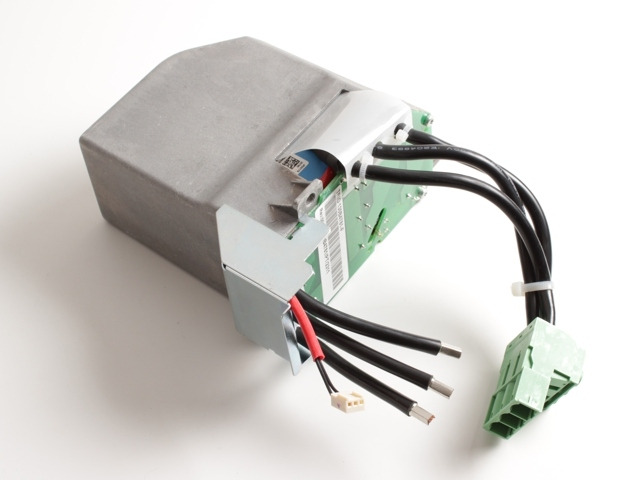
The choke reduces the current harmonics (THDi) the VFD injects into the grid. Without a choke: THDi 80–130%. With a DC choke: 30–45%. With an AC + DC choke: 25–35%.
Industrial VFDs come with a DC choke integrated into the bus. Low-cost ones almost never do, or offer it as an external option that was not quoted. Why it matters:
- IEEE 519-2022 limits TDD at the PCC. Without a choke, complying calls for active filters that cost more than the savings.
- The transformer and the neutral heat up from triplen harmonics and 5th/7th/11th order ones, and their service life is noticeably shortened (IEEE C57.110 gives the method for calculating transformer derating).
- Power factor correction capacitor banks go into parallel resonance with the harmonics and explode. We saw a plant lose the savings from 6 VFDs in a single week.
If you have several VFDs without chokes in the same panel, you are building a harmonics pump.
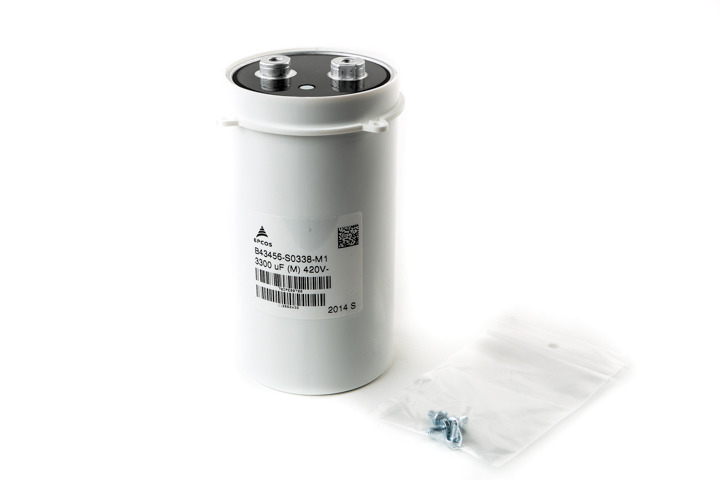
3. DC bus capacitors — the factor that most defines service life
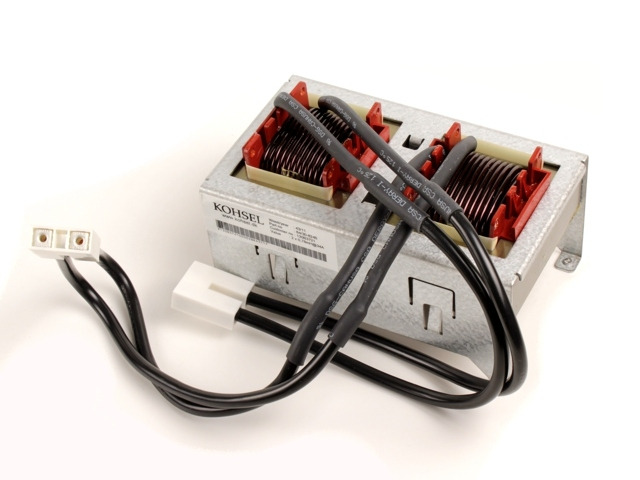
The DC bus electrolytics are the component that most determines how many years the VFD lives.
| Factor | Low-cost VFD | Branded industrial VFD |
|---|---|---|
| Manufacturer | Generic | Nichicon, Rubycon, Kemet |
| Rated temperature | 85 °C | 105 °C |
| Life at 40 °C ambient | 40,000–60,000 h | 80,000–130,000 h |
| Voltage margin | 10–20% | 30–50% |
Rule of thumb: every 10 °C lower in operation doubles the life of the capacitor. In 24/7 duty, this single factor justifies spending 40% more.
4. Conformal coating on the boards — critical in Panama
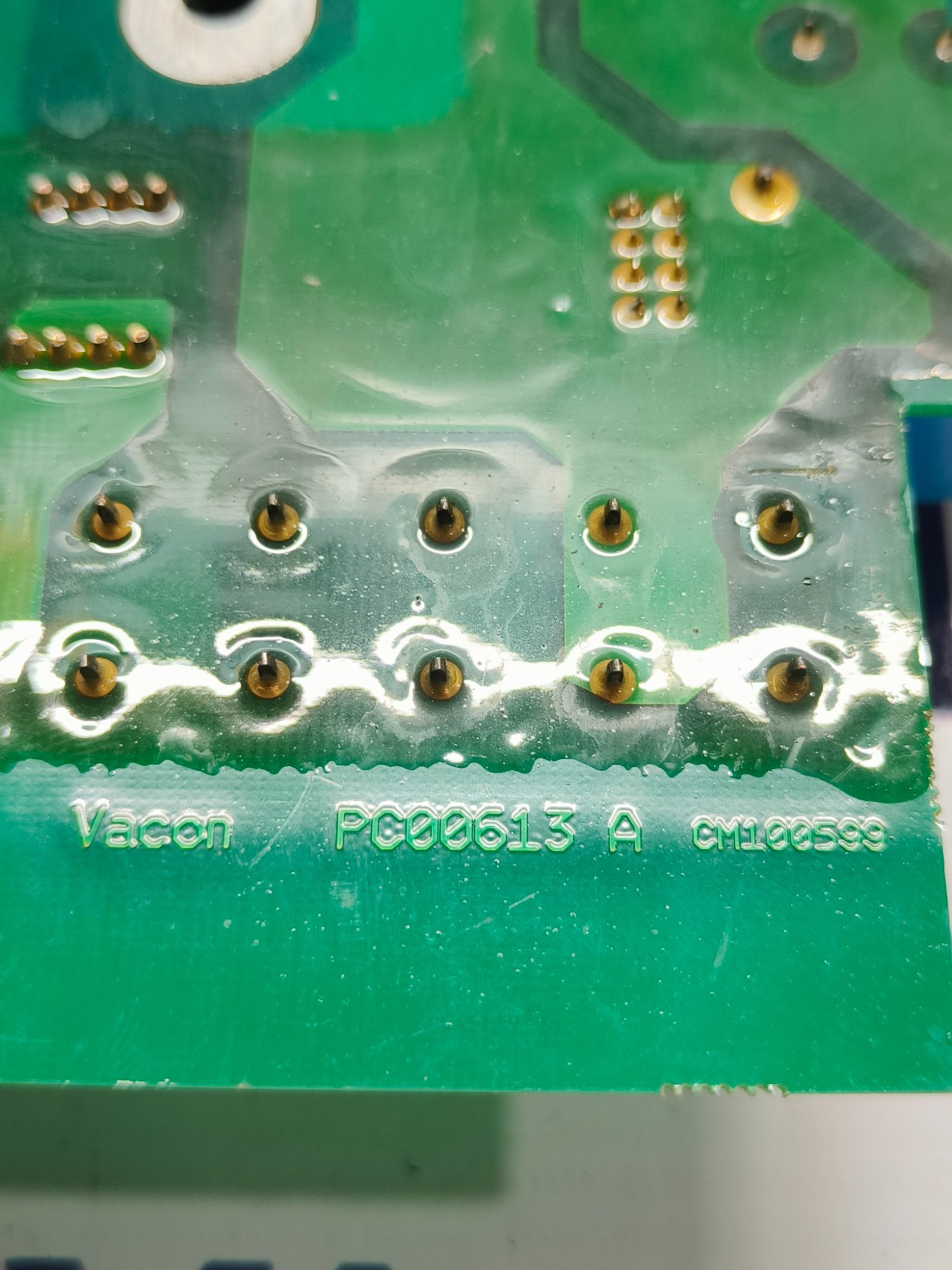
The polymer coating protects the PCBs against humidity, salt and corrosive gases. The IEC 60721-3-3 standard classifies: 3C1 controlled · 3C2 normal industrial · 3C3 aggressive industrial (coastal, food plants with washdown, chemical plants, paper mills).
Panama falls into 3C2 at a minimum, and coastal areas into 3C3. Industrial VFDs offer 3C3 coating from the factory. Low-cost ones rarely do — and without coating, within 18-24 months green corrosion appears on the traces, along with leakage and intermittent faults that are impossible to diagnose. It is the defect that turns a “low-cost” VFD into an annual consumable.
5. Heat dissipation — fans and intelligent control
Three differences the quote hides:
- Separate fans (power section + control supply) monitored by firmware vs. a single fan for everything. When the only one fails, the VFD dies.
- PID control of fan speed based on temperature → less dust, less noise, 3× the life. Low-cost units run at 100% all the time.
- Sealed bearings and a declared L10 life (60,000–80,000 h on industrial units vs 30,000 h or not declared at all). In 24/7 duty that is 6.8 to 9 years vs 3.4 years — a difference of 2 to 3× in fan life before the first replacement.
6. IGBTs and power semiconductors
- Manufacturer: Infineon, Mitsubishi, Fuji, Semikron in branded drives vs. rebranded parts in low-cost ones.
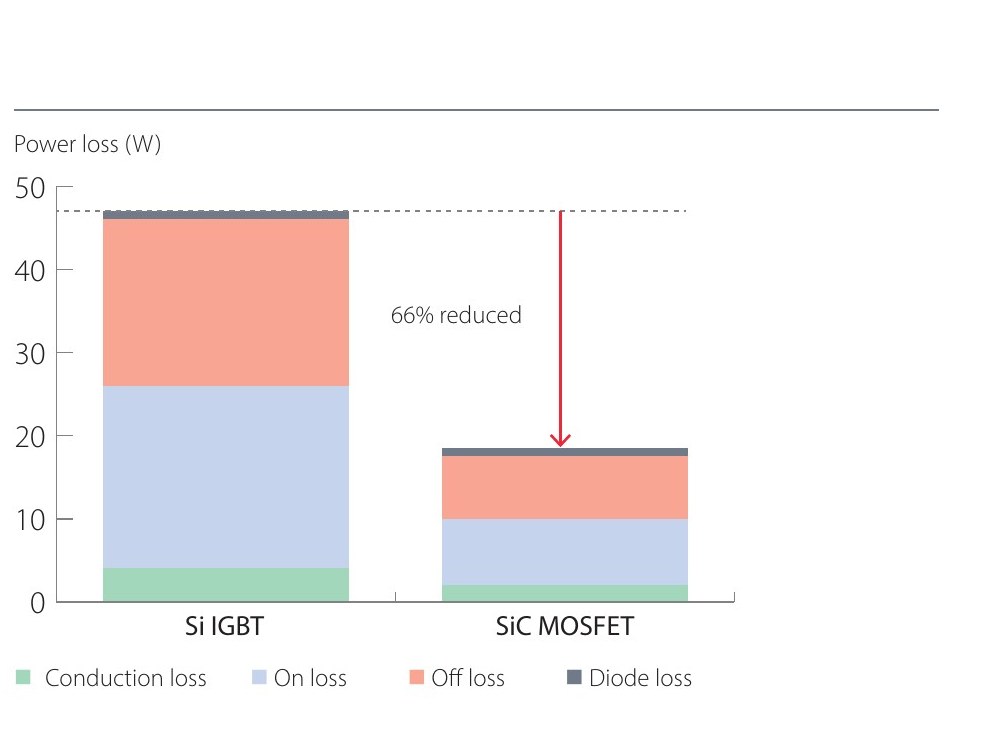
- V_CES utilization (DC bus voltage / maximum collector-emitter voltage of the IGBT): 60–70% in industrial drives — conservative operation with 30–40% in reserve. 80–90% in low-cost ones — close to the limit, with accumulated thermal stress and premature failures from grid transients.
- Switching frequency: 4–8 kHz sustained with no derating (branded) vs. heavy derating above 4 kHz (low-cost) → acoustic noise in the motor and losses.
7. Mechanical build — details the installer pays for years later
- Terminal blocks: tinned copper vs. alloy. Declared tightening torque vs. “use your judgment”.
- IP rating: IP20 with unfiltered openings lets Panamanian dust in within 6 months.
- Busbars: copper sized for the declared short-circuit rating vs. right at the edge.
- Creepage and clearances per IEC 61800-5-1, or just barely at the limit.
8. Effects on the grid and on the connected equipment
A poorly built VFD does not just fail early — it degrades the grid and the neighboring equipment before it fails itself. The effects show up in other budget lines:
- Distribution transformer: harmonics raise eddy current losses, which raises the temperature and shortens the life of the insulation.
- Saturated neutral: triplen harmonics (3rd, 9th, 15th) add up in the neutral of 3-phase 4-wire systems. They come mainly from single-phase non-linear loads (switch-mode power supplies, LED lighting, small UPS units); a three-phase VFD with no neutral hardly produces them, so the problem appears when it shares the system with those loads. Cables sized at 100% end up undersized — we have seen neutrals smoking.
- Power factor capacitor banks: parallel resonance with harmonics, amplification and explosion. Literally.
- PLCs, servos, UPS units: voltage distortion (THDv) causes resets, unnecessary battery cycles and false alarms on 4-20 mA instrumentation.
- Electricity bill: total power factor (with harmonics) can be 0.7-0.85 even though the fundamental cos φ is 0.99. In Panama, the utility calculates the low power factor surcharge from the kVArh/kWh ratio recorded by the meter; harmonics do not show up in that calculation, but they do in losses, heating and lost capacity.
- Excess harmonic emissions at the point of delivery (ASEP regulation, with IEEE 519-2022 as the technical reference) = an active filter of US$20,000-80,000.
Conclusion: saving US$1,500 on a 45 kW VFD can cost you US$15,000 in transformer, US$35,000 in active filter and the shutdown of the line when the capacitor bank blows.
9. Certifications — the ones that matter, the ones that are made up
Labels are worth exactly as much as the traceability behind them. Three levels:
Level 1 — Certifications with a verifiable issuing body (demand the certificate number):
- UL 61800-5-1 (formerly 508C) · cUL/CSA · CE with a signed EU declaration of conformity · IEC 61800-3 (EMC) · IEC 61800-5-1 and -5-2 (safety, STO with TÜV SIL 2/3) · RoHS 3 · REACH · IEC 60068-2-xx (environmental testing).
Level 2 — Sector-specific where they apply: DNV/ABS/LR (marine), ATEX/IECEx (classified areas), UL 698A, EHEDG (food), EAC/BIS/CCC/INMETRO (country by country). If your drive is going on board a ship, at Beiton Marine we confirm the classification society type approval that applies to each unit and project.
Level 3 — Worthless: “ISO 9001” on the datasheet (it belongs to the manufacturer, not to the product), logos with no verifiable number, “complies with IEC…” with no formal declaration, a “CE” marking with no declaration of conformity behind it.
Why it matters to you, not to the manufacturer:
- Your insurer may contest coverage in an electrical fire without a UL listed unit.
- A corporate audit at a multinational takes you off the approved list.
- The Panamanian electrical code (RIE) aligns with the NEC/IEC — ASEP demands documentation.
- Your signature as an integrator carries the liability if you specified an uncertified VFD.
- Uncertified STO = no legal backing in an operator accident.
The question that unmasks them: “Send me the Declaration of Conformity for the exact model, with the certificate number and the issuing body.” A serious manufacturer sends it within the hour. A supplier with nothing behind him changes the subject.
What this looks like in real life
A composite case from several Beiton interventions between 2022 and 2025, with figures adjusted to the typical range we find in the Panamanian market.
A coastal food plant bought 12 low-cost 45 kW VFDs. Initial savings: US$18,000.
At 26 months:
- 3 dead from corrosion (no 3C3 coating).
- 2 with a failed fan (bearings not sealed).
- 1 power factor capacitor bank burned out by harmonics (no DC choke).
- IEEE 519 audit rejected → mandatory active filter of US$35,000.
Net savings at 3 years: −US$23,000, not counting lost production hours. It was not a “bad brand” — it was that nobody asked the nine points before signing.
The technical checklist of 10 questions
In writing, to every supplier:
- IEC 61800-3 category of the integrated RFI filter (C1/C2 is serious; C3 calls for an external filter).
- DC choke integrated or external.
- Manufacturer, rated temperature and declared service life of the capacitor on the DC bus.
- Class of conformal coating (3C2 / 3C3 / not declared).
- Number of fans, whether they are monitored, and their L10 life.
- Manufacturer and model of the IGBT / power module.
- IP rating and replaceable air filter.
- Declared THDi at full load and total power factor (not just displacement).
- Declaration of Conformity with a verifiable UL/CE/IEC certificate number.
- IEC 60068-2-xx reports (humidity, vibration, corrosion) for the model.
If he answers “I do not know”, “it depends” or “let me check” on more than two, the price difference is not in the margin — it is in the component and in compliance.
What Beiton puts on the table
The entire Danfoss portfolio resolves these ten points from the factory — not just the high end:
- iC2-Micro (low-cost, 0.37–22 kW): C2 integrated, DC choke in the mid ranges, 105 °C capacitors, IP20/IP21.
- VLT Midi FC-280 · HVAC FC-102 · AQUA FC-202: mid and dedicated ranges with C1/C2, DC choke, 3C3 coating on the tropicalized versions.
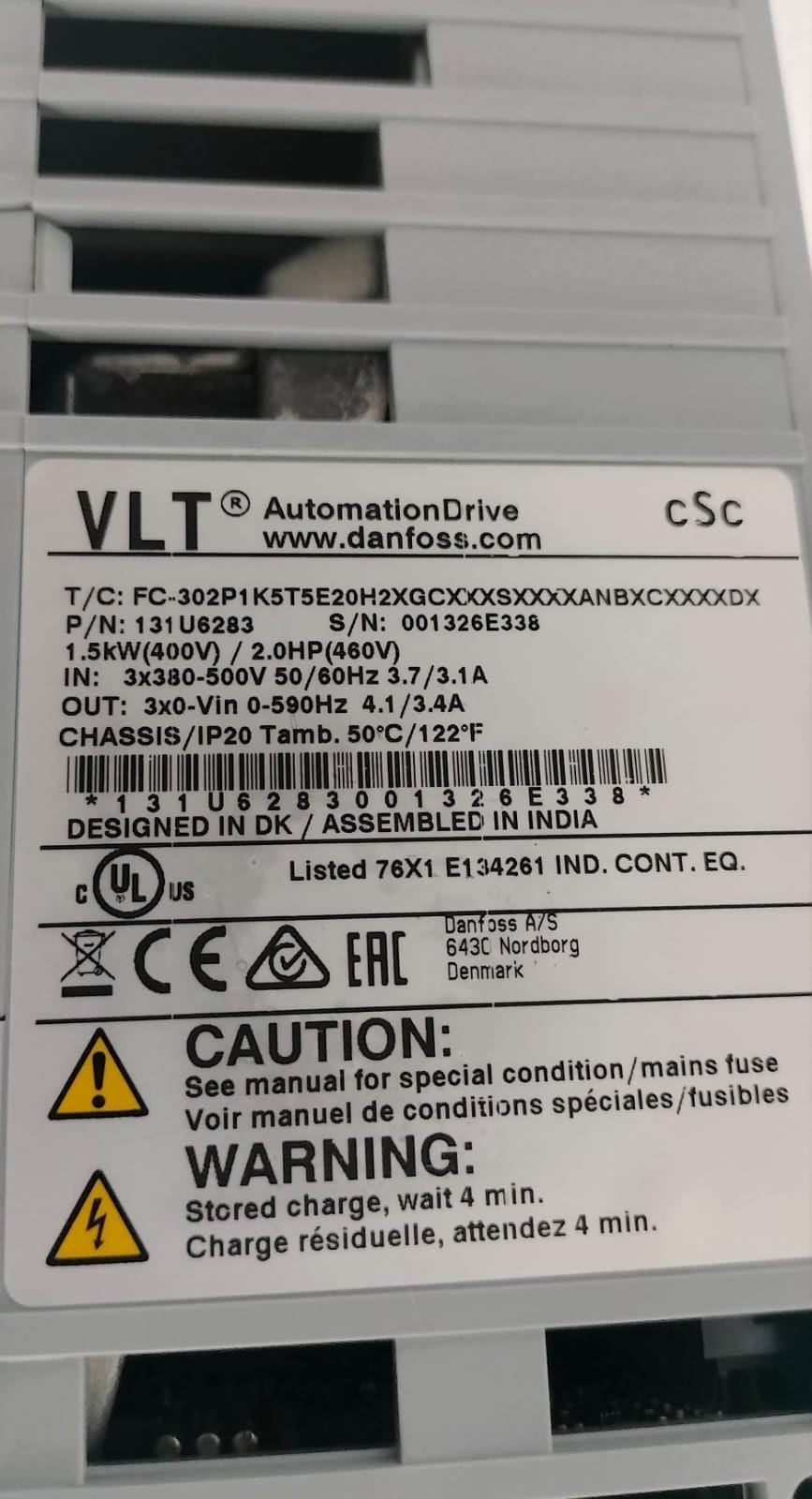
- VLT AutomationDrive FC-302 · iC7 series: full industrial build (SiC MOSFET in the iC7-HVACR ULH), efficiency >98%, L10 fans >80,000 h.
The build follows the same philosophy from the low-cost unit up to the high end. That is what a new manufacturer cannot offer until it has accumulated 20+ years. The models in local stock can be checked in our online store.