

“VFD in Panama — price vs. true cost” series · Part 3 of 4
What this installment exposes. Hardware can be audited by opening the enclosure. Firmware cannot be seen — and that is where a low-cost VFD disguises itself best: it copies the commercial names (V/Hz, “vector”, PID, STO) but implements token versions of them. Here we break down the eight algorithms and safety functions that define whether a drive really controls the motor, saves energy and protects personnel — plus two appendices on the drive’s own internal protections and on cybersecurity.
What you get out of it. You will close with eight firmware questions that add to the hardware checklist from Part 2. Together they are the acid test that mature manufacturers pass without hesitating.
The hardware is half of the variable frequency drive
Two VFDs with the same power stage can perform very differently — the difference is the firmware. On the datasheet they look the same; in the process, they do not. The following eight capabilities are the ones a mature manufacturer has had solved for 20 years.
1. AMA — Automatic motor identification
The motor has six electrical parameters that are not on the nameplate (stator resistance, inductances, rated flux, rotor time constant). AMA (Automatic Motor Adaptation) measures them by injecting test signals over 30 s to 2 min and adjusts the internal model to the actual motor.
| Capability | Industrial VFD | Low-cost VFD |
|---|---|---|
| AMA on a stopped motor (without uncoupling) | Yes, robust | Sometimes, with errors |
| AMA while rotating (more accurate) | Yes | Rare |
| PMSM / SynRM / IE4-IE5 | Yes | Standard IM only |
| Adaptation to an aged motor | Yes | No |
Without a good AMA: approximate vector control, excessive magnetizing current, inconsistent starting torque, oscillations under variable load.
2. VVC+ vs. basic V/Hz
Classic V/Hz works, but it responds poorly to load changes. VVC+ (Voltage Vector Control Plus) — Danfoss developed it in the 90s — compensates for stator resistance in real time and holds constant torque from about 0.5 Hz without an encoder.
Measurable differences:
- Starting torque at low frequency: V/Hz 80-100% at 2 Hz · VVC+ 150-180% at 0.5 Hz. Critical on pumps against back pressure and on loaded conveyors.
- Stability at no load: V/Hz oscillates · VVC+ does not.
- Recovery from a disturbance: VVC+ is 3-5× faster.
Many low-cost VFDs claim “vector control” but implement V/Hz with manual boost — which demands expert parameter setup and ages badly with motor temperature.
3. Flux Vector Control (FVC) — when precision is not negotiable
For applications with real demands on torque and speed, FVC is the standard. It controls flux and torque current decoupled from each other.
- Sensorless FVC: speed accuracy of 0.5%, torque response of 50 ms.
- Closed loop with encoder: accuracy of 0.01%, rated torque at 0 rpm indefinitely, bandwidth >100 Hz.
Mandatory applications: extruders, winders, elevators, cranes, textiles, printing, multi-axis synchronization.
A low-cost VFD that “says it has FVC” without declaring speed accuracy or bandwidth is selling a label. Ask it for the sustained torque vs. speed curve and the response time to a torque step. If it does not deliver that, it does not have it.
4. AEO — Automatic energy optimization
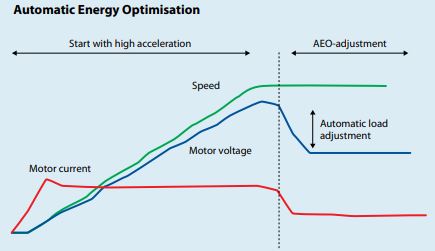
The algorithm that pays for the VFD by itself in applications where partial load dominates. Most VFDs keep the motor magnetized at 100% no matter the load — pure iron waste. AEO measures the load and reduces flux to the minimum needed.
- 5% to 15% electrical savings on PID-modulated pumps, VAV fans and screw compressors.
- Lower motor temperature → longer insulation life.
- Lower acoustic noise.
A concrete case — a 45 kW pump, 8,000 h/year, 60% load:
- AEO savings of ~8% = 17,280 kWh/year
- Industrial tariff in Panama (~US$0.18/kWh): US$3,110/year
The algorithm is not trivial (thermal model, indirect torque measurement, a loop that must not destabilize). Low-cost VFDs rarely implement it well.
5. Flying Start — catching a spinning motor
Starting into a motor that is already spinning (inertia, process flow, wind on an exhaust fan) without synchronizing generates a massive short-circuit current → trip or damage to the IGBT.
Flying Start detects speed and direction, synchronizes voltage and starts with no shock. Essential on draft fans, pumps in parallel and conveyors with a descending load. Industrial units come with it bidirectional; low-cost ones make it unidirectional or leave it out — which forces you to wait for a complete stop before every start.
6. Kinetic Backup / Inertia Ride-Through
The Panamanian grid has frequent dips (100 ms to 2 s). A VFD with no protection trips on every one of them.
Kinetic Backup uses the motor’s inertia to regenerate the DC bus during the dip, reducing speed by 1-3% to “surf” the sag without tripping. Documented result at 3 Panamanian plants we have worked with: 70-90% fewer trips from dips <500 ms. One concrete case (a plastics plant, 75 kW extruder, 2023) went from 18 stoppages/month to 3/month simply by enabling this function when migrating from a drive without backup to a VLT AutomationDrive FC 302.
It requires fine control of the DC bus and of the flux — low-cost units rarely implement it well.
7. Motor protections — they are not all the same
VFDs claim to protect the motor. The question is how:
- ETR thermal model (Electronic Thermal Relay) — per IEC 60034-11 (thermal protection of the motor) with curves equivalent to class 20 of IEC 60947-4-1: the industrial unit combines current + speed + thermal memory after shutdown. The low-cost one uses a linear I²t that resets on every start → the motor overheats progressively without the drive detecting it.
- Stall detection: industrial by current + speed + time. Low-cost only by sustained overcurrent — a 1-2 s stall damages gearboxes without being detected.
- Output phase loss: industrial by imbalance. Low-cost only by overcurrent — the motor keeps turning on two phases until it burns out.
- Input phase loss: industrial by DC bus ripple. Low-cost only by undervoltage — too late for the capacitors.
- Ground fault: industrial detects imbalance at 5-10%. Low-cost only a hard fault >50%.
- PTC/KTY/PT100 wired straight into the VFD: standard on industrial units. Rare on low-cost ones — which forces external thermal relays.
8. Safety functions (STO, SS1, SLS) — with certification
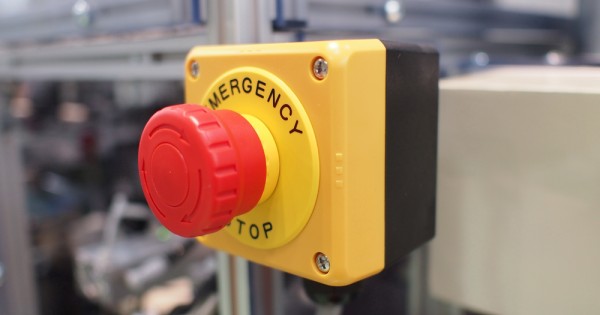
STO (Safe Torque Off) removes torque without cutting the supply. It is the building block of any emergency stop under EN ISO 13849 / IEC 62061.
Low-cost units often claim “STO” without certification: no failure mode analysis, no channel redundancy. In an accident it protects you neither legally nor technically.
Industrial units declare SIL 2 or SIL 3 (IEC 61508/62061), PL d/e (ISO 13849-1), Cat. 3/4, with verifiable TÜV certification. Additional functions in the high end: SS1 (controlled stop), SLS (safely limited speed), SDI (safe direction), SOS (position held with torque).
If operators interact with the machine, these functions with TÜV behind them are the difference between a design that passes a safety audit and one that does not.
Appendix A — The VFD’s own protections
- DC bus precharge: controlled contactor or thermistor (mature) vs. a fixed resistor that ages (low-cost).
- Capacitor monitoring: the industrial unit estimates remaining life and warns at 80%; the low-cost one lets you watch the BOOM.
- Fan monitoring: the industrial unit detects a drop in RPM before overtemperature.
- Event log with timestamp: 100-500 events with data (industrial) vs. 5-10 with no context (low-cost).
Appendix B — Cybersecurity and firmware updates
With VFDs increasingly connected (Modbus TCP, PROFINET, EtherNet/IP, OPC UA), the latest generation of drives (iC7 and equivalents) implements IEC 62443-4-2, per-user authentication, digitally signed firmware, access logging and ports that can be disabled.
Low-cost units rarely mention cybersecurity — open protocols with no authentication are a door to industrial ransomware. They also tend to ship with firmware frozen at manufacture: if there is a bug, you live with it.
A direct question: “Is there a public record of firmware updates for this model over the last 3 years?” The answer tells you whether the product is alive or disposable.
A real case — the electricity bill
8 low-cost VFDs on 30 kW pumps, 7,500 h/year, 55% load. Migration to VFDs with AEO + VVC+ + kinetic backup:
- Measured energy savings: 9.3% per year
- Stoppages from dips: from 22/month to 4/month
- Emergency direct starts: −60% (flying start)
The energy savings alone paid back the difference in investment in 22 months. The rest was net margin.
The firmware checklist of 8 questions
In writing, add these to the hardware checklist from Part 2:
- AMA on a stopped motor and while rotating. Does it support PMSM/SynRM?
- Available control modes: V/Hz, VVC+ (or equivalent), sensorless FVC, FVC with encoder.
- AEO and the typical savings declared by the manufacturer.
- Flying Start, bidirectional.
- Kinetic Backup, configurable.
- IEC 60947-4-1 class of the ETR, and thermal memory.
- STO with TÜV SIL 2/3 and a verifiable report number.
- Public record of firmware updates for the model.
What Beiton integrates — the same platform at every range
Firmware capabilities are not exclusive to the high end. The VVC+/AMA/AEO platform has been refined over 20+ years and is present across the whole Danfoss drive portfolio, scaling by model:
- iC2-Micro — VVC+, basic AEO, flying start, class 20 ETR, optional STO. Firmware inherited from VLT, not improvised.
- VLT Midi FC-280 — AMA while rotating, AEO, kinetic backup, certified SIL 2 STO.
- VLT HVAC FC-102 / AQUA FC-202 — everything above + fire mode, pump cascade, sleep/wake, dry pump detection.
- VLT AutomationDrive FC-302 — sensorless and closed-loop FVC, STO SIL 2/3 + SS1 + SLS with TÜV, MCO 305 for motion.
- iC7 series — next-gen FVC, adaptive AEO, IEC 62443-4-2, updatable firmware, integrated predictive monitoring.
You are not paying for a “high-end bonus” — you are paying for a platform proven in millions of installations over decades, where each level gets the mature functions that suit it.
Part 4 closes the series with lifecycle, spare parts over 10-15 years and the real ROI.